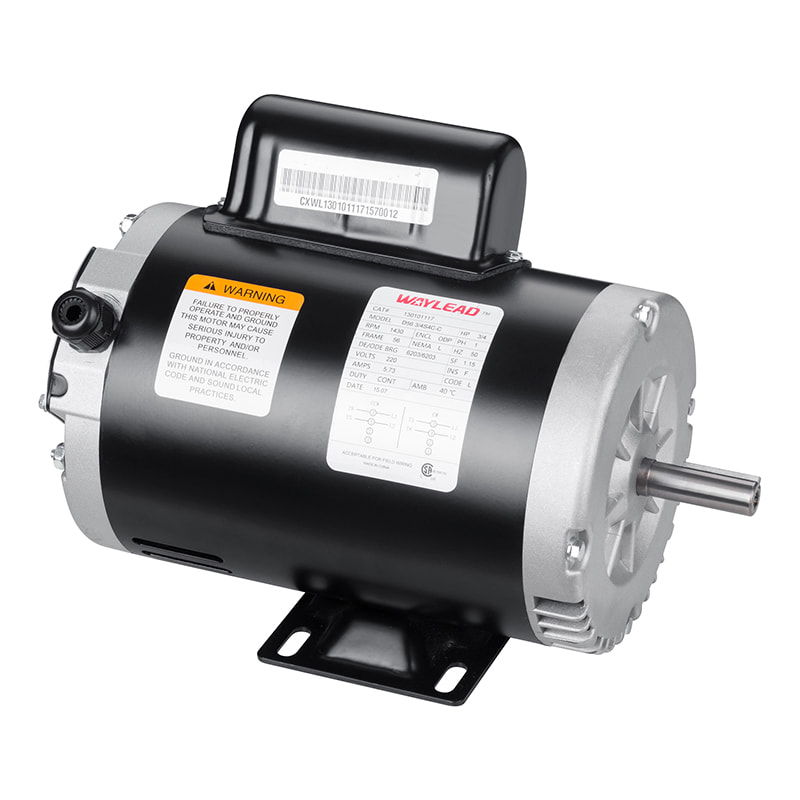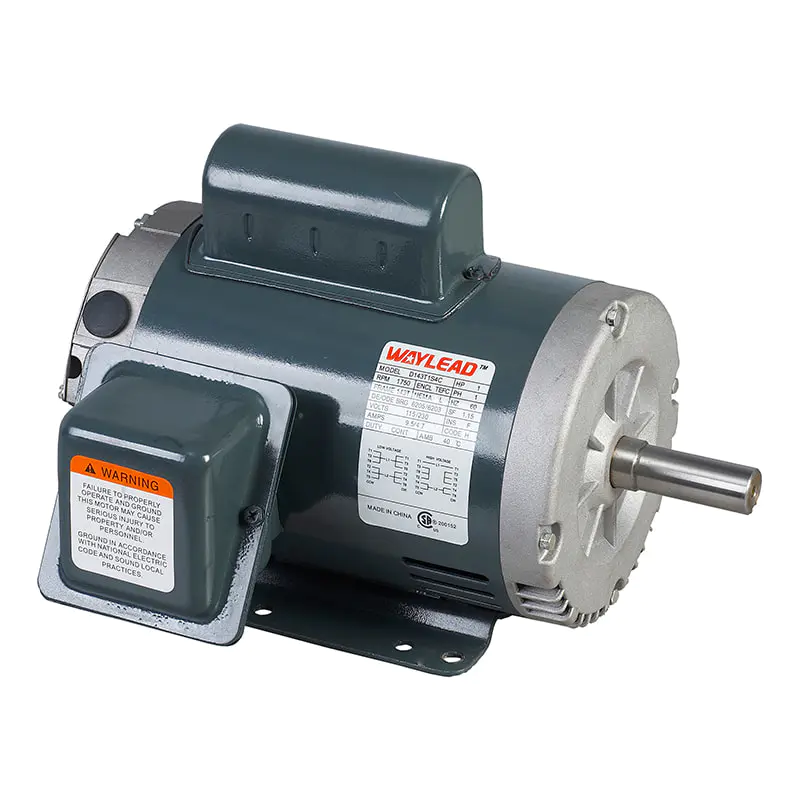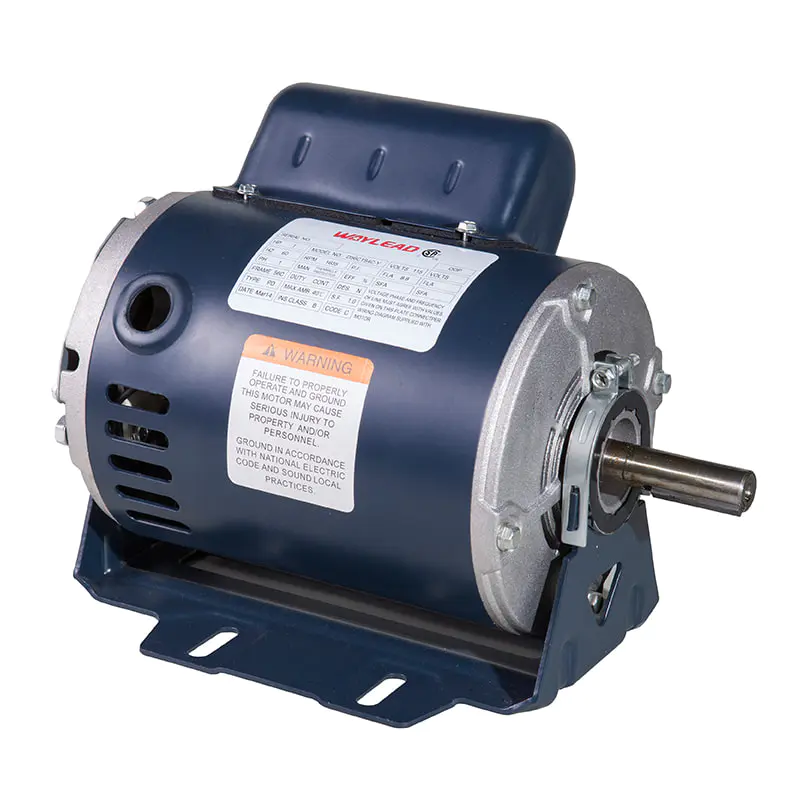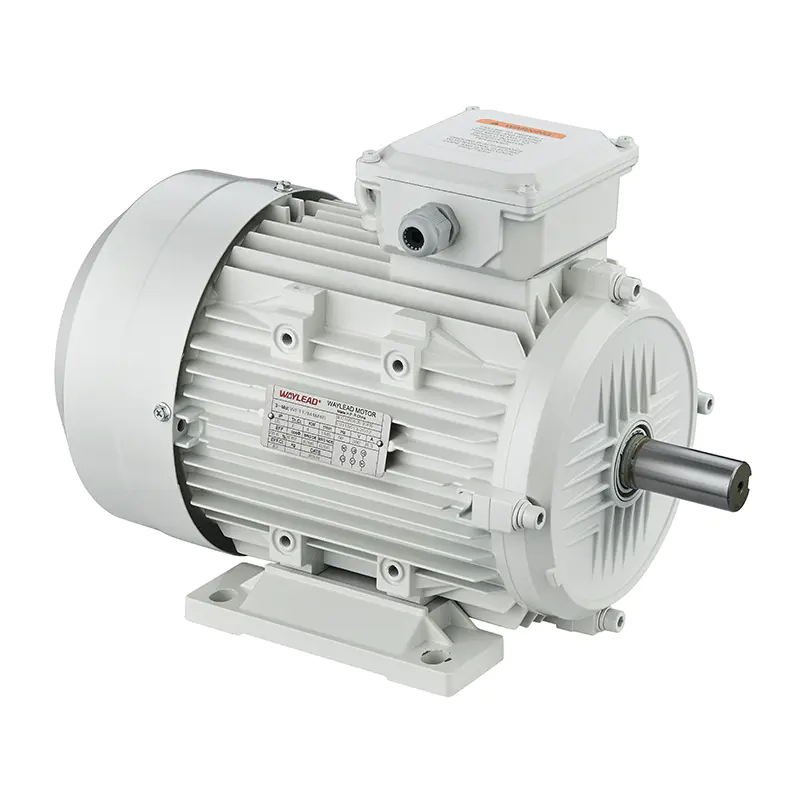
Short answer: a single-phase motor can run from a three-phase supply, but only when it is fed one phase conductor plus the neutral at the voltage stamped on its nameplate. It can never use all three phases at once; the third conductor simply stays unused. If the system has no neutral, or the voltage available does not match the nameplate, the motor will either refuse to start or overheat and fail.
That is the answer in two sentences. What follows explains why, shows what each common three-phase supply actually delivers, and covers the reverse question that most people are really asking: how to run a three-phase motor when single-phase power is all you have.
Why a Single-Phase Motor Cannot Use All Three Phases
A single-phase motor has two supply terminals. Inside the frame sits a main run winding, usually an auxiliary or start winding, and a capacitor or centrifugal switch that drops the auxiliary winding out once the rotor reaches speed. The starting scheme assumes one sinusoidal voltage applied across two points.
A three-phase supply is made of three conductors whose voltages sit 120 electrical degrees apart. A two-terminal device can only bridge two of those points, either phase to phase or phase to neutral. Because of that, the real questions are narrower than the headline question:
- Voltage match: does the available single-phase voltage equal the motor nameplate value?
- Neutral path: in a four-wire system, is a neutral present at the motor and sized for motor current?
- Starting current: can the branch handle the three to five times running current drawn for a fraction of a second at every start?
What Each Three-Phase Supply Actually Delivers
"Three-phase" is not one voltage, and that is where most mistakes start. The table below lists the systems you meet in North America, Europe and export markets, and what a single-phase motor sees on each of them.
| Supply system | Phase-to-phase | Phase-to-neutral | Can a 230 V single-phase motor run? |
|---|---|---|---|
| 120/208 V wye, 4-wire | 208 V | 120 V | No, 120 V is far below the nameplate rating |
| 277/480 V wye, 4-wire | 480 V | 277 V | No, 277 V overheats a 230 V winding |
| 400/230 V wye, 4-wire (IEC) | 400 V | 230 V | Yes, phase to neutral, exactly as designed |
| 240 V delta, 3-wire | 240 V | None | Yes, line to line, if the motor is rated 240 V |
| 240 V delta with high leg, 4-wire | 240 V | 120 V on two legs, 208 V on the high leg | No for 230 V; only 120 V motors suit the lighting legs |
A 230 V motor tolerates roughly plus or minus 10 percent, so about 207 V to 253 V. Outside that band, a rewind or a replacement is the next step.
Where the Damage Usually Happens
Three failure patterns account for nearly every service call on this topic.
Line-to-line connection at the wrong voltage
A 230 V motor landed across two lines of a 400 V system sees 400 V. Insulation stress rises immediately, the run capacitor usually fails first, and the winding often follows within minutes.
No neutral, or an undersized one
Three-wire delta systems have no neutral at all, so there is no single-phase path available at the machine. In four-wire systems the neutral is sometimes a thin control conductor that was never intended to carry motor current. It needs to be sized to the branch circuit, not to a pilot light.
Driving a single-phase motor from a three-phase VFD
A standard drive with three-phase output cannot run a capacitor-start motor. The pulsed output works against the capacitor and the centrifugal switch, and the auxiliary winding is not positioned to accept a synthetic rotating field. Drives with a dedicated single-phase output do exist, but the starting circuit has to be reworked with the motor supplier involved, not improvised on site.
The Reverse Question: Running a Three-Phase Motor on Single-Phase Power
Most people searching this topic actually face the opposite problem: a three-phase motor on site with only single-phase power available. The short answer is the same in spirit, never connect it directly.
Put a three-phase motor on a single-phase line and there is no rotating magnetic field. The rotor sits still, the motor hums, current climbs toward locked-rotor level, and the overload trips or the winding burns. Every workable method below creates the missing third phase artificially.
| Method | How it works | Usable power | Best suited to |
|---|---|---|---|
| Direct connection | Two leads only, no rotating field | None | Never, this destroys the motor |
| Static phase converter | Capacitors create a start and run phase | About 50 to 60 percent of nameplate | Light, occasional loads with no hard starting |
| Rotary phase converter | An idler motor generates the third phase | Close to 100 percent | Shops with several machines that need real starting torque |
| VFD with single-phase input | Rectifier and inverter synthesise three phases | About 50 percent unless oversized | One motor that also needs speed control |
| Replace with a single-phase motor | Matches the motor to the supply on hand | 100 percent of the new rating | Loads up to roughly 3 HP at 230 V |
Two numbers decide whether conversion is worth the trouble. Standard full-load current tables put a 230 V single-phase motor at about 8 A for 1 HP, 17 A for 3 HP and 28 A for 5 HP, with a starting surge three to five times higher. And when a VFD is fed from single-phase, the input current concentrates in fewer devices, so the drive must be sized for roughly twice the motor current to keep the rectifier and DC bus inside their ratings.
Single-Phase or Three-Phase: What Actually Changes
When both supplies are available, the decision comes down to five measurable differences.
- Starting torque: a three-phase motor develops roughly 200 to 300 percent of full-load torque at start; a capacitor-start single-phase motor manages about 150 to 200 percent, and a permanent split capacitor design much less.
- Current per horsepower: three-phase machines draw roughly half the current of a single-phase motor of the same rating, so cables, contactors and overloads are smaller and cheaper.
- Efficiency and power factor: both run higher on three-phase, which is why premium efficiency programmes are written around them.
- Frame size: for the same horsepower, a single-phase motor is typically one or two frame sizes larger and noticeably heavier.
- Practical ceiling: above about 3 HP the single-phase option stops making sense because of starting current and conductor size. A fuller comparison of construction and performance is covered in our breakdown of single-phase and three-phase motor differences.
A Checklist Before You Wire Anything
- Photograph the nameplate: voltage, phase, frequency, horsepower, full-load amps and service factor.
- Measure the supply at the point of connection with a true-RMS meter, both phase-to-phase and phase-to-neutral, ideally under load.
- Confirm the neutral exists and matches the branch circuit rating.
- Check that the contactor and overload relay suit the motor current and duty cycle.
- Inspect the capacitors and verify the centrifugal switch moves freely before reusing an old motor.
- Confirm rotation before coupling the driven equipment, and match the enclosure to dust, washdown or outdoor conditions.
Matching the Motor to the Supply You Have
If the supply is 230 V single-phase and the load stays under about 3 HP, a totally enclosed capacitor start and run motor is usually the simplest answer, and it avoids conversion equipment altogether.
 Single-Phase Totally Enclosed Capacitor Start Run MotorWorth viewing for 230 V single-phase loads under about 3 HP, offering a totally enclosed capacitor start and run option that avoids conversion equipment.View Product →
Where three-phase power is already in the building, a premium efficiency three-phase machine in a 48 or 56 frame does the same job with lower current, better starting torque and a longer service life.
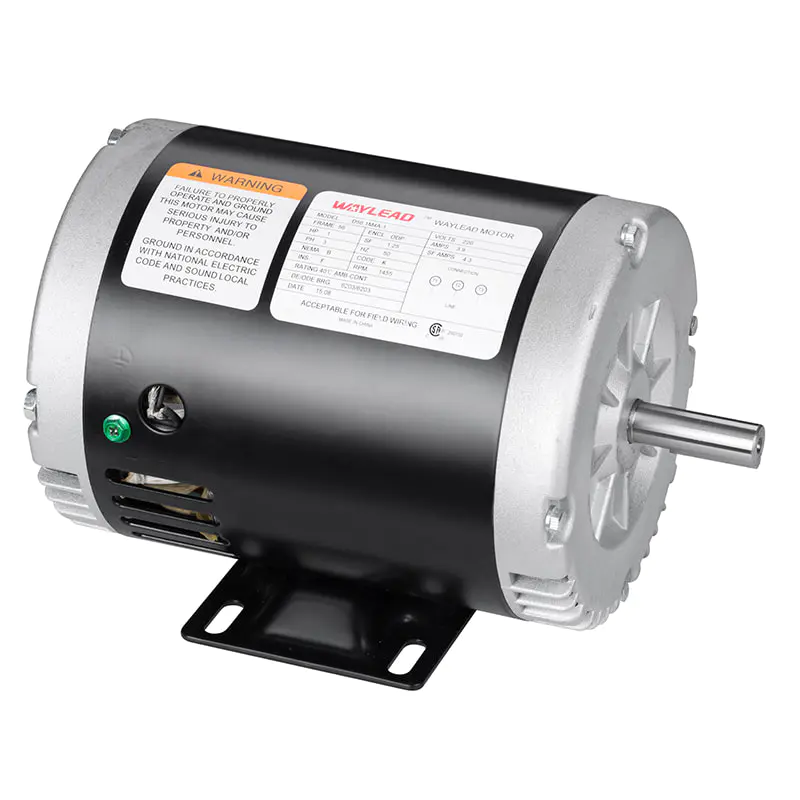 Three-Phase Fractional Horsepower Premium Efficiency MotorWorth viewing where three-phase power is available, this 48–56 frame premium efficiency motor suits light-duty industrial loads with lower current and longer service life.View Product →
If the driven equipment needs variable speed but only single-phase power is available, an EC motor sidesteps the whole conversion problem, because the electronics handle commutation and the motor itself has no start capacitor or centrifugal switch to fight with a drive.
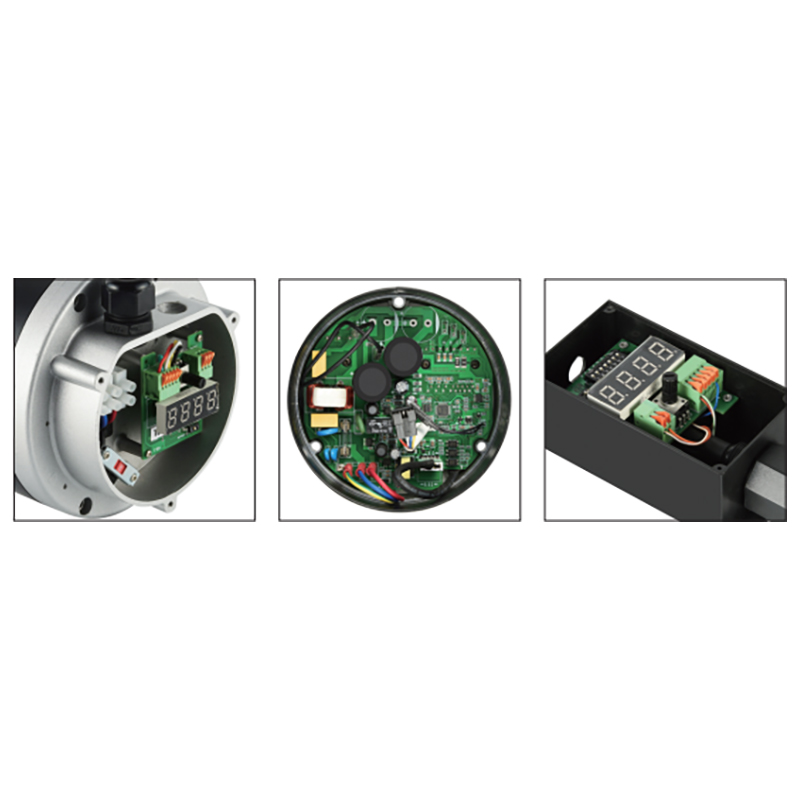 NEMA Frame EC Motor for Single-Phase Variable-Speed EquipmentWorth viewing for variable-speed equipment on single-phase power, this NEMA 48 frame EC motor avoids start capacitors and centrifugal switches while handling commutation electronically.View Product →
Frame sizes, enclosure types and efficiency levels have to line up as a set, which is easier when one supplier covers both single-phase and three-phase families. WAYLEAD builds NEMA and IEC designs from 48 to 250 frame, in dripproof, totally enclosed and TENV construction, so the same load can be matched to whichever supply the site actually has.
Frequently Asked Questions
Can a single-phase motor run on two lines of a three-phase supply?
Yes, provided the line-to-line voltage equals the nameplate rating. A 240 V motor on a 240 V delta system is a normal installation. It is still single-phase power, and the third line goes unused.
What happens if I connect a 230 V single-phase motor to a 400 V supply?
The winding sees roughly 74 percent overvoltage. Magnetising current climbs steeply, the capacitor is overstressed, and the winding overheats within minutes. The result is usually a burnt run winding and a bulged capacitor.
Can a VFD run a single-phase motor from a three-phase supply?
A standard three-phase output drive cannot. Single-phase output drives exist, but the starting capacitor and centrifugal switch must be reworked and the motor has to tolerate inverter waveform. For most retrofits, replacing the motor is cheaper than adapting it.
How large can a single-phase motor be before three-phase is the better choice?
Capacitor-start single-phase motors are readily available up to about 3 HP, and occasionally 5 HP, at 230 V. The full-load current at those sizes, 17 A and 28 A respectively, plus a starting surge three to five times higher, usually makes three-phase the practical choice above 2 to 3 HP.
The rule that keeps this simple: match the motor to the supply you have, rather than forcing a motor onto a supply it was never designed for. Read the nameplate, measure the voltage phase to neutral and phase to phase, confirm the neutral, and check the starting current against the branch protection. When any of those four checks fails, the answer is a different motor, not a different connection.