A 2 HP air compressor that trips a 20 A breaker on a cold morning is not a defective motor. It is electric motor physics doing exactly what it is supposed to do: a single-phase capacitor-start winding draws heavy locked-rotor current, and cold oil in the crankcase raises the torque needed to bring the pump up to speed. Change the starting method or the motor design, and the nuisance trip disappears.
That example is the reason this article exists. The short answer behind it is this: torque comes from the Lorentz force acting on current-carrying conductors, speed comes from the balance between supply voltage and the back EMF the rotor generates, and everything you pay for in efficiency is a fight against copper and iron losses.
The rest of the article turns those three statements into the specifications you compare every day — frame size, service factor, locked-rotor torque, insulation class and efficiency band — and flags the places where the physics is routinely misread during selection.
What Electric Motor Physics Actually Governs
Every number on a motor datasheet is the visible output of a small set of physical relationships. Once you can match a field symptom to the underlying principle, selection stops being guesswork.
| Principle | What it means inside the machine | Where it appears on paper |
|---|---|---|
| Lorentz force (F = B·I·L) | Current flowing in a conductor inside a magnetic field experiences a force; applied at the rotor radius, that force becomes torque. | Rated torque, locked-rotor torque, breakdown torque. |
| Faraday's law and back EMF | Conductors moving through a field generate a voltage that opposes the supply, so the rotor must slow slightly before net current can flow. | No-load speed versus full-load speed, percent slip. |
| Lenz's law | Induced currents always oppose the change that created them, which is why the rotor chases the rotating field instead of outrunning it. | Direction of rotation, the hard ceiling at synchronous speed. |
| Rotating magnetic field | Three currents displaced 120 degrees produce a field of constant magnitude that sweeps around the stator at synchronous speed. | Smooth torque, low vibration, inherent self-starting. |
| Phase splitting | A single-phase supply gives a pulsating field with no rotation; an auxiliary winding plus capacitor creates a second phase so the field can turn. | Starting torque, inrush current, capacitor rating, start versus run windings. |
| Magnetic saturation | Iron can only carry so much flux; past the knee of the B-H curve, extra current buys almost no extra torque. | Voltage tolerance, and why low voltage overheats rather than simply derates. |
Three Laws That Decide Whether a Motor Starts and How It Runs
Torque is a force at a radius, not a marketing number
Motor torque is the Lorentz force multiplied by rotor radius and conductor count, which is why torque rises with current — but only until the iron saturates or the winding overheats. That single sentence explains the shape of every speed-torque curve you will ever read.
For a NEMA Design B motor, locked-rotor torque typically sits around 150 to 200 percent of rated torque and breakdown torque around 200 to 300 percent. A fan or centrifugal pump needs almost nothing at zero speed, so it starts easily. A loaded conveyor, a reciprocating pump, or an air compressor fighting cold oil may need 200 percent or more simply to break away. When an application stalls, the useful question is not "is the motor big enough?" but "which point on the torque curve is failing?"
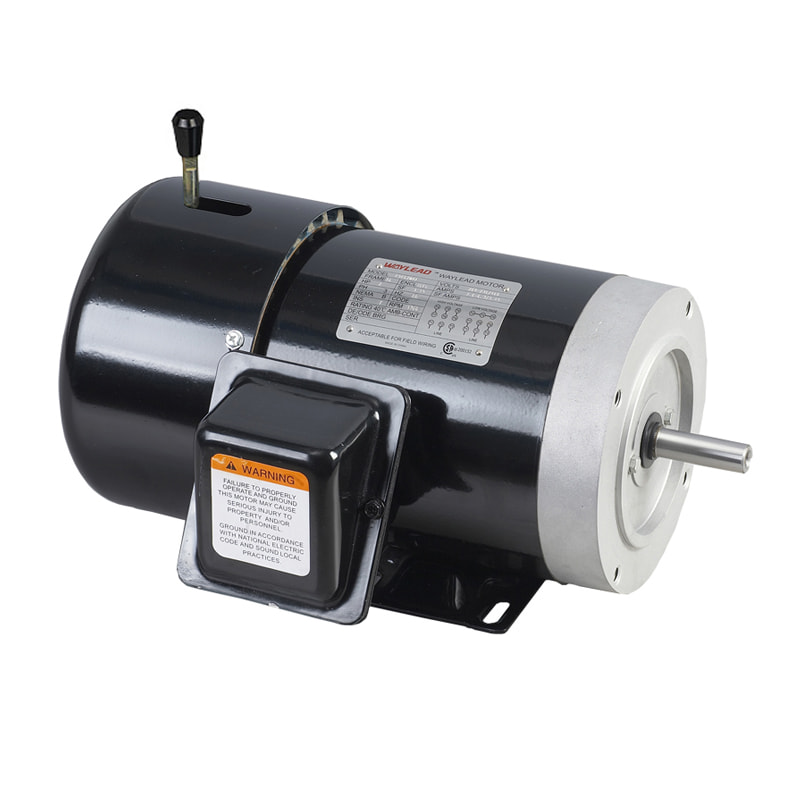
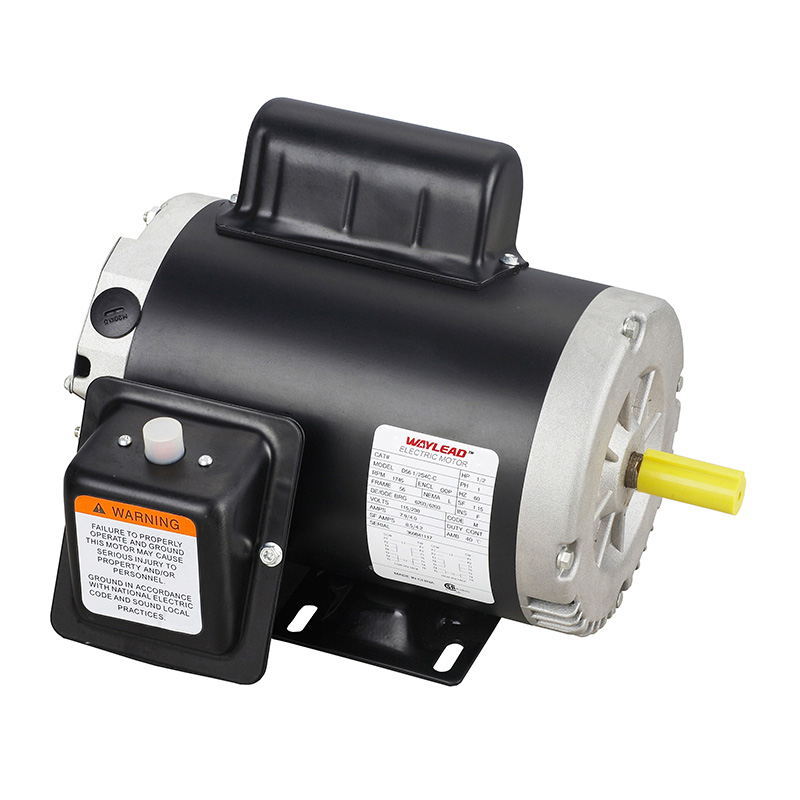 Dripproof Single-Phase Capacitor Start MotorSingle-phase capacitor-start ODP motor, 1/3–2 HP across NEMA 56/140T frames, suited to equipment needing breakaway torque on single-phase supply.View Product →
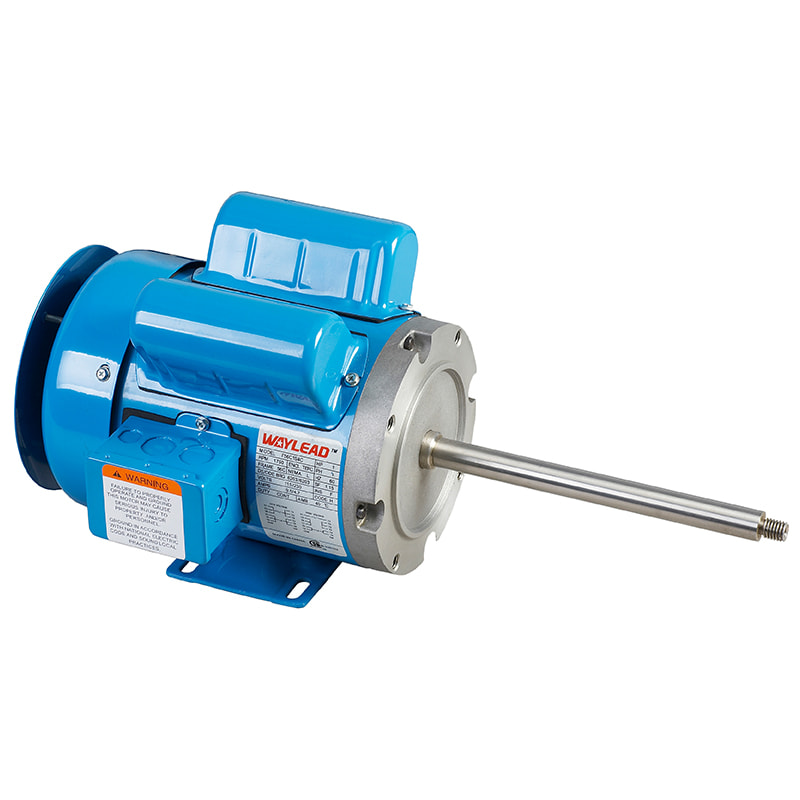
The practical route to more breakaway torque on a single-phase supply is a capacitor-start design: a large electrolytic capacitor in the auxiliary winding delivers the extra starting torque, then drops out once the rotor is turning.
Back EMF sets the operating point
A motor accelerates until the voltage it generates internally almost cancels the supply voltage. That generated voltage is back EMF, and the small remainder is what actually drives current through the winding to make torque. Speed is therefore governed by frequency and pole count, not by load:
| Poles | Synchronous speed (60 Hz) | Typical full-load speed | Indicative slip |
|---|---|---|---|
| 2 | 3600 rpm | 3450-3520 rpm | 2.2-4.2% |
| 4 | 1800 rpm | 1725-1760 rpm | 2.2-4.2% |
| 6 | 1200 rpm | 1140-1170 rpm | 2.5-5.0% |
| 8 | 900 rpm | 850-880 rpm | 2.2-5.6% |
Slip is not a defect; it is the mechanism that lets current flow at all. But it is also a load gauge. A motor running at 1 percent slip is nearly unloaded and running at a poor power factor. A motor running well past its nameplate slip is overloaded and converting the difference into rotor heat.
Voltage behaves with the same logic. Because back EMF scales with speed and field strength, a motor at 90 percent of rated voltage must draw noticeably more current to hold the same shaft torque. That extra current becomes copper loss, and the winding runs hotter at exactly the moment the supply is weakest.
Three phases rotate; one phase must be tricked into rotating
A single-phase winding produces a field that pulses along one axis rather than rotating, so at standstill it develops zero net torque and the rotor never starts on its own. Adding an auxiliary winding and a capacitor shifts that winding's current by roughly 90 electrical degrees, creating a second field displaced in space and time — enough to start rotation. After that, the main winding carries the load and the auxiliary winding either stays in as a run winding or drops out through a centrifugal switch or relay.
Three-phase motors need none of that trickery. Three windings 120 degrees apart create a field of constant magnitude rotating at synchronous speed, so starting is inherent, torque is smooth, and there is no capacitor to fail in the field. If you want the detailed picture of that rotation, see how a three-phase motor works.
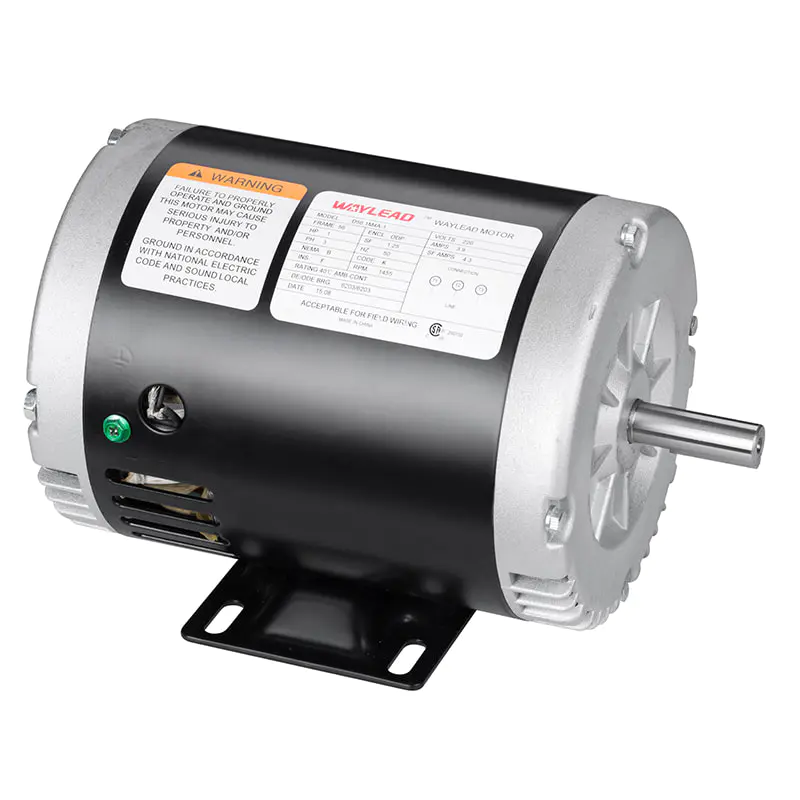 Three Phase Fractional Horsepower Premium Efficiency MotorThree-phase fractional-horsepower premium efficiency motor with 48–56 frames, ODP IP23 enclosure, and no starting capacitor; view for light-duty industrial drives.View Product →
Fractional-horsepower three-phase motors are the clearest demonstration: same shaft output, smaller frame, higher starting torque and no starting capacitor anywhere in the bill of materials.
Single-Phase or Three-Phase: What the Physics Costs You
If three-phase power is available at the installation, a three-phase motor is almost always the better engineering choice — smaller frame, higher starting torque, lower current per horsepower, and noticeably less vibration.
| Characteristic | Single-phase | Three-phase |
|---|---|---|
| Starting torque | Depends entirely on winding design and capacitor sizing; can be strong but is never uniform | Inherent and consistent, typically 150-200% of rated torque |
| Starting current | High inrush, aggravated by capacitor switching | High but predictable, usually 6-8 times rated current |
| Frame size for equal HP | Larger, because the pulsating field wastes active material | Smaller and lighter at the same rating |
| Vibration and noise | Double-line-frequency pulsation is built into the design | Constant-magnitude rotating field, much smoother |
| Efficiency ceiling | Lower, and premium efficiency is harder to certify | Higher; IE2 and IE3 bands are routinely achievable |
| Field maintenance | Capacitors, switches and relays are wear items | Fewer consumable parts, longer service intervals |
Where the Physics Turns Into Heat: Losses and Efficiency
Not all electrical input becomes shaft power, and the shortfall is not one loss but four families that behave differently as load and speed change.
The four loss families
- Stator copper loss (I²R) — proportional to current squared, so it climbs steeply with load and with any voltage deficit.
- Rotor copper loss — proportional to slip, which is why an overloaded motor heats up faster than its current reading suggests.
- Iron loss — hysteresis and eddy currents in the core, roughly constant once the motor is energized, even at no load.
- Mechanical loss — bearing friction and windage, small but always present and sensitive to lubrication and ventilation.
- Stray load loss — leakage flux and harmonic effects that are awkward to calculate and easy to underestimate.
Efficiency is shaft power divided by input power, so every one of those losses is a direct tax. It also explains a real design trade-off: a premium-efficiency motor is not a standard motor with better paint. It typically uses more active material — a longer core, more copper, lower-loss electrical steel and a tighter air gap — precisely to attack these losses.
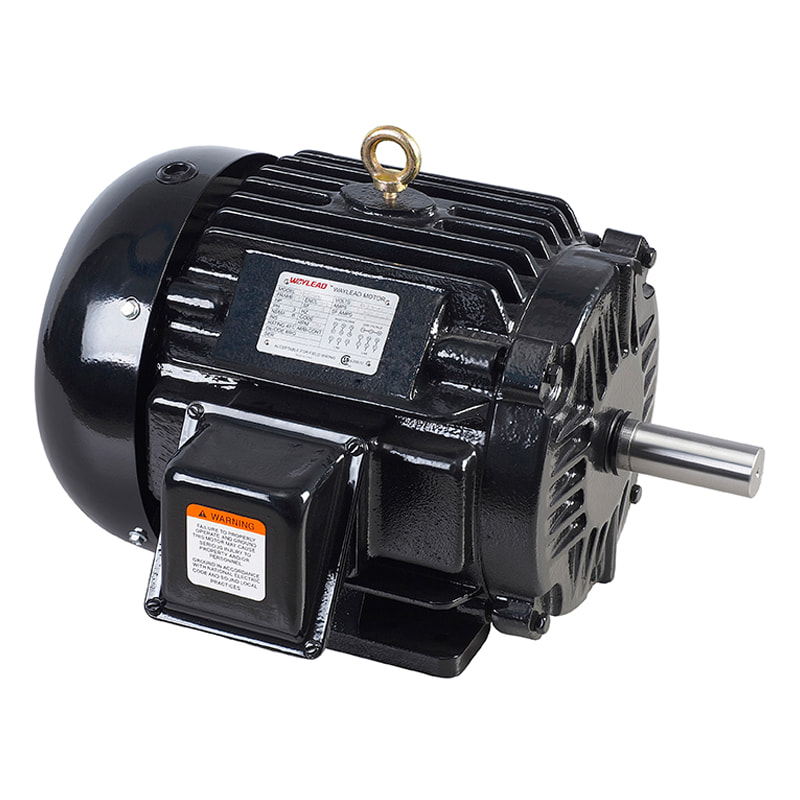
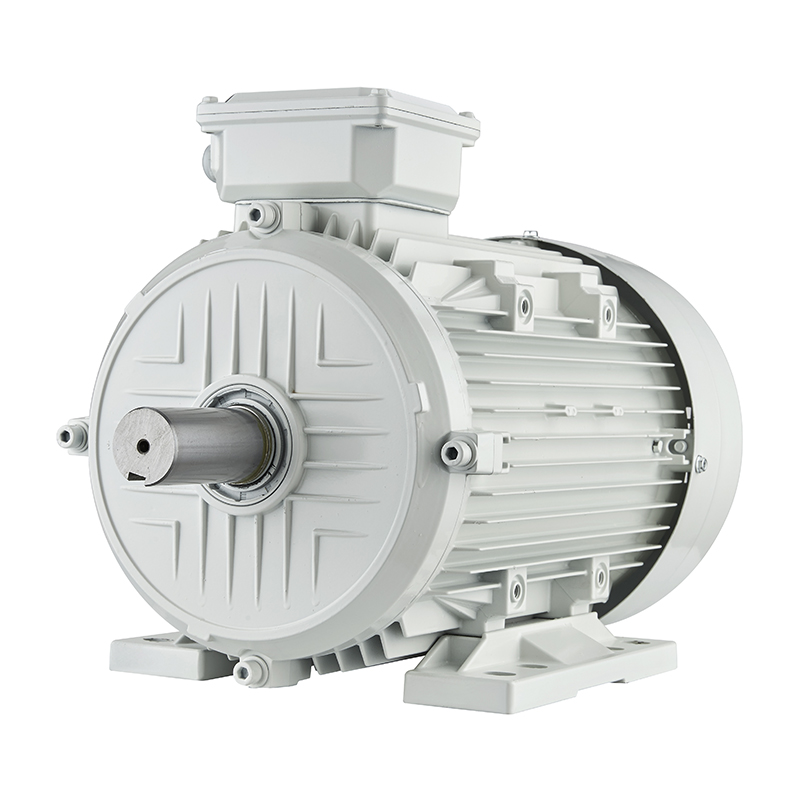 IEC IE3 Premium Efficiency Motor SeriesIEC IE3 premium efficiency motor series from 0.75–37 kW, 2/4/6-pole, TEFC IP55; view for reduced losses over machine life.View Product →
That is the reasoning behind IEC IE3 premium efficiency designs: the extra material is paid for by reduced losses over the life of the machine, not by a marketing claim.
Temperature is where this becomes expensive. Insulation systems are rated for a maximum hot-spot temperature, and a widely used rule of thumb is that insulation life roughly halves for every 10 °C of sustained operation above the rated limit. Two motors with the same nameplate horsepower can therefore have very different service lives if one is sitting at 1.05 service factor continuously and the other is idling at half load.
Five Physics Misconceptions That Cause Bad Motor Choices
- "A bigger motor is always safer." An oversized motor runs at very low slip and low power factor, drawing magnetizing current it never converts into work. The result is a hotter, noisier, less efficient installation.
- "More horsepower automatically means more starting torque." Starting torque is set by rotor design and winding arrangement, not by the horsepower number alone.
- "Supply voltage barely matters, since the motor draws what it needs." Lower voltage means more current for the same torque, and that deficit turns directly into copper loss and heat.
- "Slip means the motor is failing." Slip is the normal mechanism that lets current flow. Only slip beyond the nameplate value signals overload.
- "Efficiency only affects the electricity bill." Losses appear as heat, and heat is what shortens insulation life, bearing grease life and ultimately the whole machine.
FAQ: Electric Motor Physics in Day-to-Day Selection
Why does a motor draw six to eight times its rated current at startup?
At standstill the rotor is not moving, so back EMF is zero and the only thing limiting current is winding impedance, which is small. As the rotor accelerates, back EMF rises and current falls toward the running value. That is why a motor takes far longer to trip a thermal overload than a magnetic breaker — and why soft starters and capacitor-start designs exist.
Does power factor matter if I am billed in kilowatts?
Power factor tells you how much of the current is doing useful work. A low power factor means the same shaft output requires more current, which means more I²R loss and a larger conductor and switchgear requirement. Utilities often penalize it directly, and the motor itself runs hotter regardless.
Can a 60 Hz motor run on 50 Hz?
Volts per hertz is the governing ratio. Reducing frequency without reducing voltage proportionally pushes the core toward saturation, and the motor draws excessive magnetizing current and overheats. If both voltage and frequency drop together, the motor runs slower and cooler but produces less horsepower.
What does a 1.15 service factor mean physically?
It means the insulation and magnetic circuit can tolerate roughly 15 percent above rated output without exceeding their thermal limits, assuming rated voltage, altitude and ambient temperature. It is a margin for occasional peaks or unusual conditions, not a permanent license to run the motor at 115 percent.
Is a 4-pole motor always better than a 2-pole motor?
No. Two-pole motors are lighter and cheaper per horsepower but run faster, wear bearings sooner and are noisier. Four-pole motors offer a better balance of speed, torque and mechanical life, which is why they dominate general-purpose industrial applications.
Key Takeaways
- Torque comes from the Lorentz force; speed comes from the balance between supply voltage and back EMF.
- Slip is functional, not a fault. Use it as a load indicator against the nameplate value.
- Single-phase motors need phase splitting to start; three-phase motors start inherently and run smoother.
- Efficiency is the sum of copper, iron, mechanical and stray losses — reducing them costs active material up front and pays back in heat and life.
- Undersized conductors, low voltage and overloaded service factors all reach the same destination: excess winding temperature.
Sizing a motor well means reading the physics rather than the horsepower label. If you want to compare concrete designs against these principles, the WAYLEAD motor range covers single-phase and three-phase machines from 1/10 to 20 HP in NEMA 48 through 250 frames, so the torque, slip and efficiency differences described here can be checked against real datasheets rather than theory alone.