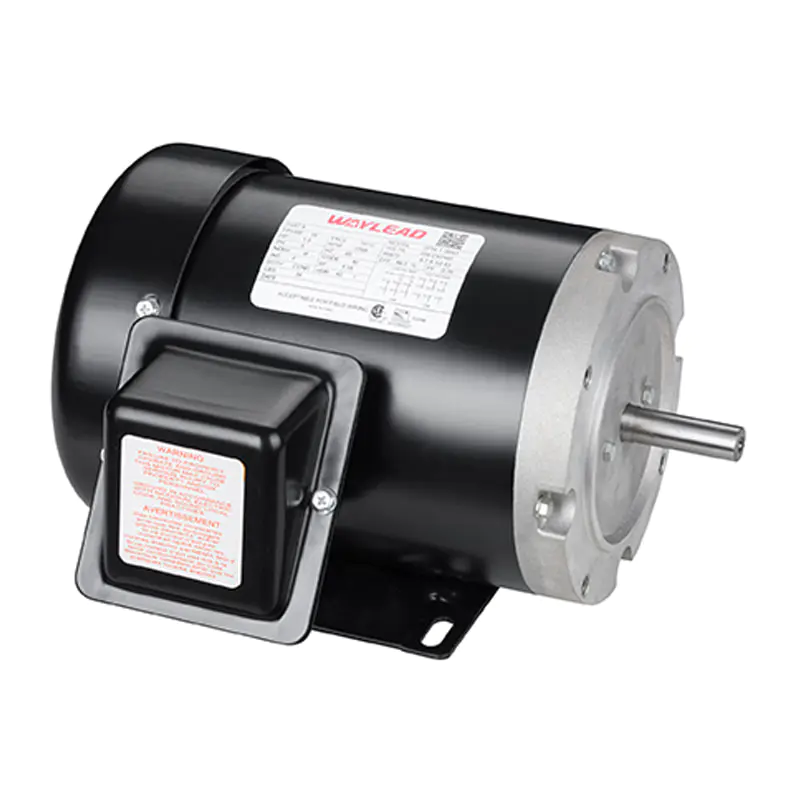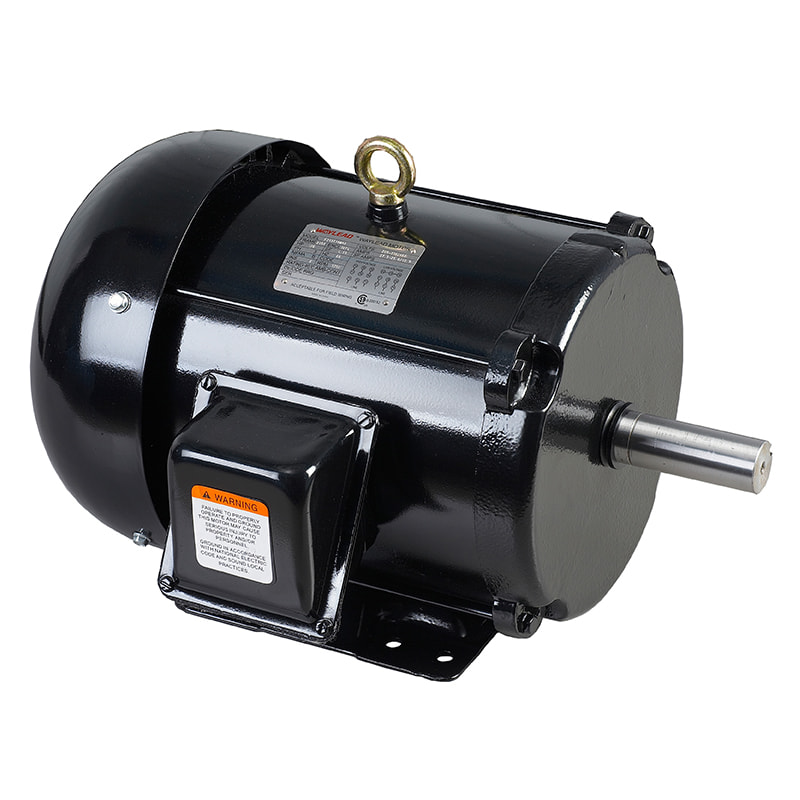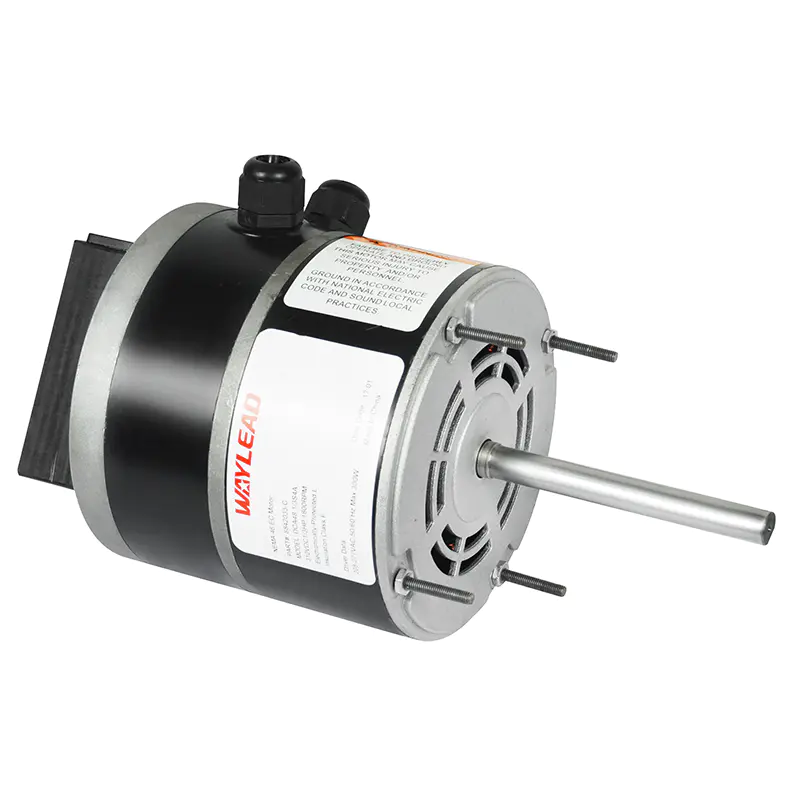
Heavy duty industrial electric motors are defined by duty cycle, torque curve and service environment rather than by horsepower alone. If a machine runs sixteen hours a day, starts under load, or sits in a dusty or wet plant, the details that decide whether the motor survives are starting torque, service factor, insulation class, enclosure and bearing quality. Buyers who compare only frame size and price usually find out the difference six months later, when the first winding fails.
This guide walks through the specification lines that actually matter, the trade-offs behind each one, and the procurement checks that catch most expensive mistakes before the order is placed.
What separates a heavy duty motor from a general purpose one
Heavy duty is a duty-cycle and environment rating, and it shows up in about six specification lines on the nameplate and datasheet.
- Service factor: 1.15 continuous at rated ambient is the usual industrial baseline; general purpose consumer motors often carry 1.0.
- Insulation: Class F minimum, with Class H for high ambient or high-altitude sites. A Class F winding running at Class B temperature rise buys real thermal margin.
- Starting torque: locked-rotor torque in the 150–250% of full-load range, depending on the design letter, so the motor can break the load away without stalling.
- Enclosure: totally enclosed fan cooled (TEFC) at IP55 is the default in most plants; open drip proof (ODP) belongs in clean, dry, indoor rooms only.
- Frame and bearings: cast iron frames resist vibration and corrosion better than rolled steel; roller bearings handle belt-driven radial loads that ball bearings cannot.
- Rated conditions: 40 °C ambient and 1000 m altitude. Above either, output must be derated rather than assumed.
A 1 HP motor on a pump running around the clock is heavy duty work. A 15 HP motor switched on twice a day in a clean workshop is not. Duty, not size, is the dividing line.
Matching torque design to how the load actually starts
Most early failures in heavy duty industrial electric motors trace back to a torque curve that does not match the way the driven machine starts.
Centrifugal pumps and fans start almost unloaded, so a standard NEMA Design B motor is fine. Conveyors, positive-displacement pumps, screw compressors and crushers start loaded, and they need higher locked-rotor torque plus a starter or drive that limits inrush. Hoists, indexing tables and packaging lines need the load held when power drops, which is a braking question rather than a horsepower question.
| Load behaviour | Design or feature to specify | Practical effect |
|---|---|---|
| Centrifugal pump, fan | Design B, TEFC, IE3 or NEMA Premium | Low starting torque demand, best efficiency at rated point |
| Loaded conveyor, screw compressor | Design B or C, higher locked-rotor torque, soft starter or VFD | Reliable breakaway without nuisance trips |
| Crusher, mixer, positive-displacement pump | Design C or D, oversized frame, roller bearings | Handles high inertia and shock loading |
| Hoist, indexing table, machine tool axis | Brake motor with fail-safe spring-applied brake | Holds position when power is removed |
| High-start-frequency duty (more than 10 starts per hour) | Inverter duty, Class F or H, separate cooling if fan-cooled | Controls winding heating from repeated inrush current |
When a machine needs both drive and holding, a brake motor removes a separate brake, coupling and control circuit from the design. Three-phase units are the usual choice above roughly 2 HP because the brake coil and release voltage stay simple.
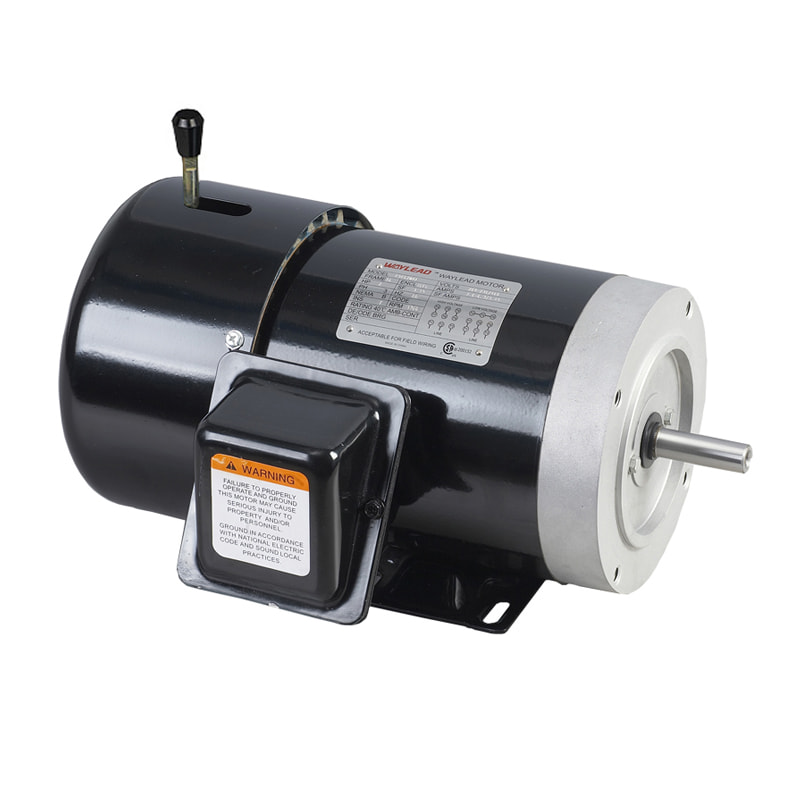 Three-Phase Brake MotorApply to braking requirement situations, such as: sudden parking, elevator, windlass, etcView Product →
The practical check is to ask for the speed-torque curve, not just the horsepower. A motor rated 5 HP at full speed may still fail to accelerate a high-inertia load if its pull-up torque dips in the middle of the curve.
Enclosure choices that decide service life
A TEFC cast iron motor is the sensible default for heavy duty plant duty, and any move away from it should be justified by a specific hazard.
Open drip proof motors cool better and cost less, but they pull in dust, metal fines and moisture with the cooling air. TEFC motors enclose the winding and rely on finned surfaces plus an external fan, which suits dusty and humid rooms. Where the fan itself would clog — flour dust, food processing, lint — a totally enclosed non-ventilated (TENV) motor avoids the problem at the cost of running hotter, so it is normally selected one frame size larger.
- IP55 covers dust and low-pressure water jets: standard plant duty.
- IP65 suits washdown areas and outdoor installations without a roof.
- Condensation drains and space heaters are worth specifying for cold starts, high humidity, or equipment that stands idle for weeks.
- Cast iron versus aluminium: cast iron holds bearing alignment under vibration and resists corrosion in damp rooms; aluminium saves weight where the motor is carried or mounted on a moving frame.
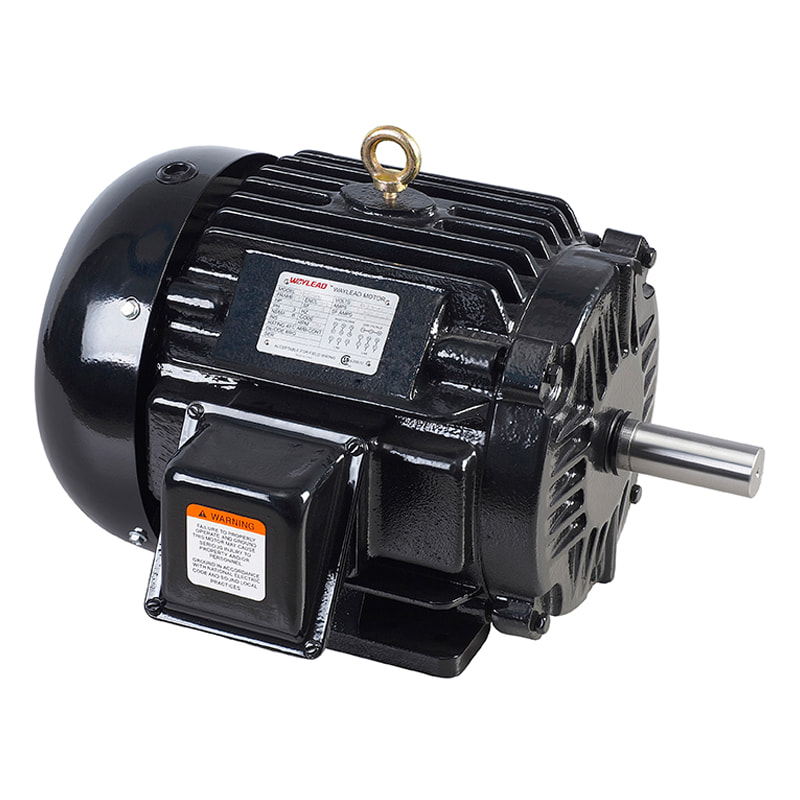 Totally Enclosed Cast Iron Premium Efficiency MotorsCast-iron TEFC motors from 1–10 HP, with C-face kit option for applications where dust/moisture protection and concentric mounting alignment matter.View Product →
Mounting detail matters as much as the enclosure. A C-face mount guarantees concentric alignment with a gearbox or pump; foot-mounted units depend on shimming and coupling alignment, which is where a large share of bearing failures begin.
Efficiency rules shape what you are allowed to buy
Efficiency regulation, not catalogue preference, now determines which motor can be sold for continuous industrial duty in North America and Europe.
In the United States, general purpose motors in the 1–500 HP band must meet NEMA Premium levels. Canada follows a similar path, and the EU requires IE3 for comparable ratings, with IE2 accepted only when controlled by a variable frequency drive. Because the rules apply to continuous duty, they directly affect almost every heavy duty industrial electric motor installation.
| Rating | IE2 (high efficiency) | IE3 / NEMA Premium | Input power saved at full load |
|---|---|---|---|
| 1.5 kW / 2 HP | 84.5% | 87.0% | About 50 W |
| 3.7 kW / 5 HP | 88.4% | 89.6% | About 120 W |
| 7.5 kW / 10 HP | 90.4% | 91.3% | About 185 W |
| 15 kW / 20 HP | 91.9% | 92.6% | About 280 W |
The savings look small per motor until hours are multiplied in. A 10 HP motor running 4000 hours a year at 91.3% instead of 90.4% draws roughly 185 W less, which is about 740 kWh — meaningful across a plant with forty such motors, and enough to repay the price difference within a couple of years in most electricity markets.
Two cautions apply. First, nameplate efficiency is measured at 100% load; a motor that spends its life at 40% load will not deliver the catalogue figure, which is why sizing to the real load profile matters more than chasing the highest class. Second, the difference between the two efficiency tiers is narrower than the difference between a correctly sized motor and an oversized one. The comparison between efficiency classes is worth reading in more detail before committing a specification. IE2 versus IE3 efficiency differences
A procurement checklist that prevents most returns
Order from a written specification sheet, not from a horsepower number, and require the manufacturer to confirm each line in writing.
- Duty profile: hours per day, starts per hour, load inertia, and whether the load starts loaded.
- Torque requirement: locked-rotor, pull-up and breakdown torque against the driven machine's curve.
- Electrical supply: voltage, frequency, phase, and whether a VFD will be used — inverter duty windings and a wider speed range change the specification.
- Mechanical interface: frame size, foot or C-face mount, shaft diameter and keyway, rotation direction.
- Environment: ambient temperature, altitude, humidity, dust, washdown, and any corrosive atmosphere.
- Compliance: efficiency class, plus UL or CSA recognition where the installation is inspected.
- Documentation: test report to IEEE 112 or IEC 60034-2-1, speed-torque curve, outline drawing, and spare parts list.
- Commercial terms: lead time, warranty period, and whether a replacement frame can be sourced quickly.
Standard ranges are easier to compare when the frame sizes line up; browsing a three-phase motor range with published frame, pole and efficiency data makes the shortlist faster than exchanging drawings one at a time.
Where heavy duty motors earn their price
The applications that justify a heavier specification are the ones where downtime costs more than the motor.
In practice that means water and hydraulic pumps, air compressors, conveyors, mixers, woodworking machinery, bake ovens, refrigeration and pool or spa circulation. A pump motor that runs continuously needs a stable thrust load path and seals that suit the fluid. A compressor motor needs high starting torque and good heat rejection in an enclosed canopy. A hydraulic power pack needs a motor matched to the pump's displacement and pressure curve, since overload is the normal failure mode rather than a rare event.
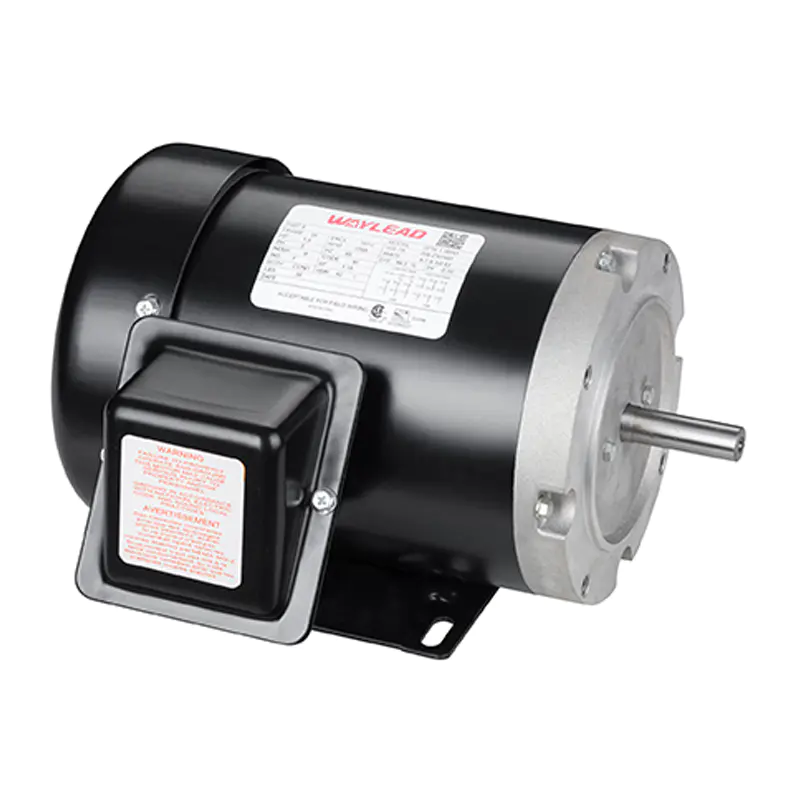 Hydraulic Pump Motors in 56C and 56HC FramesRolled-steel TEFC motors from 1–3 HP for hydraulic power packs, with 56C/56HC frames and single- or three-phase options.View Product →
Across all of these, the cheapest long-term decision is usually to buy one frame size above the absolute minimum and run it below its thermal limit, provided the efficiency penalty at part load is checked.
The three failure modes worth designing against
In-service failures cluster around misalignment, moisture and sustained overload, and all three are preventable at specification and installation stage.
- Misalignment: keep shaft alignment within about 0.05 mm and recheck after the machine has run warm; belt tension that is too tight overloads the front bearing.
- Moisture: insulation resistance should stay above roughly 1 MΩ per kV of rated voltage plus 1 MΩ; below that, dry the winding before energising and fit a space heater.
- Overload: set the overload relay to the nameplate full-load current, and verify voltage imbalance stays under 1% — a 3% imbalance can push winding temperature up by far more than 3%.
Trend vibration readings monthly rather than annually. Bearing defects show up in the spectrum weeks before they become a shutdown.
Frequently asked questions
What horsepower range counts as heavy duty?
There is no fixed threshold. Fractional horsepower motors from 1/10 HP upward can be heavy duty when they run continuously or start under load, and industrial ranges commonly extend to 20 HP in NEMA 48 to 250 frames. Judge the duty profile first and the horsepower second.
Should I run a motor at its 1.15 service factor continuously?
No. The service factor is a margin for occasional overload, voltage imbalance or slightly higher ambient — not a second rating. Designing a machine to sit permanently at 115% load shortens insulation life and usually voids the efficiency figure you paid for.
Is TEFC always better than TENV?
TEFC is better wherever cooling air is reasonably clean, because the fan keeps the winding cooler at full load. TENV wins in fibrous or floury dust where a fan would clog or where particles must not be blown around; expect to derate it and select a larger frame for the same output.
Can a single-phase motor handle heavy duty work?
Yes, up to roughly 3–5 HP. Capacitor-start designs deliver good breakaway torque for compressors and pumps. Above that range, three-phase motors are smaller, more efficient, free of centrifugal switches and capacitors, and cheaper per horsepower, so they are the better engineering choice whenever three-phase power is available.
How do I verify an efficiency claim before ordering?
Ask for a test report referencing IEEE 112 Method B or IEC 60034-2-1, and check that the value is stated at rated load with the ambient and altitude conditions named. A catalogue number without a test standard behind it should not be accepted for a continuous-duty installation.