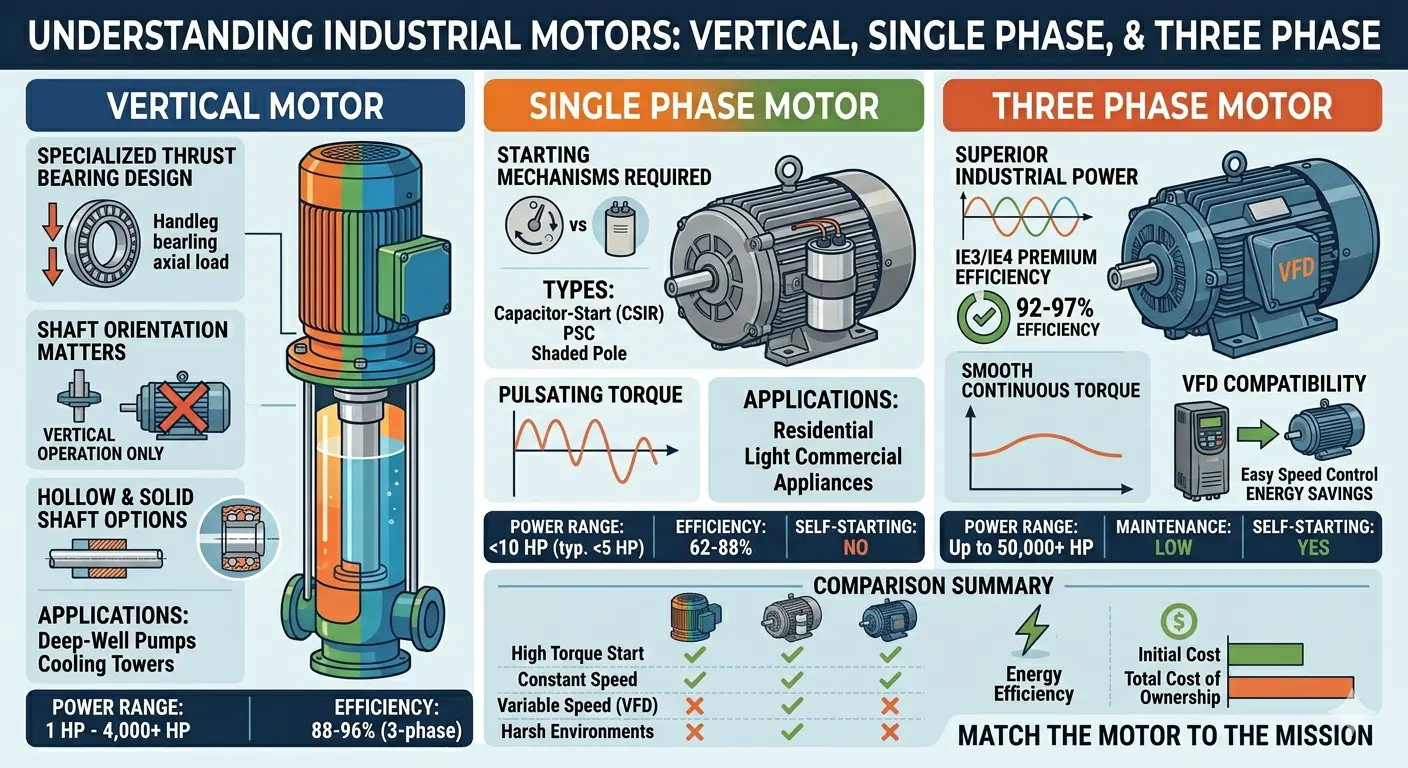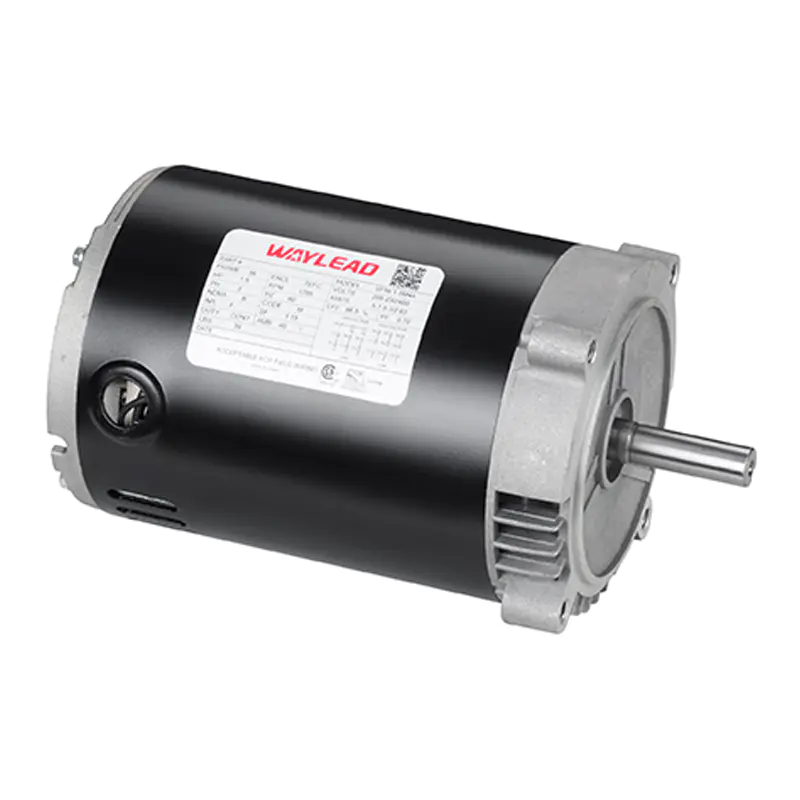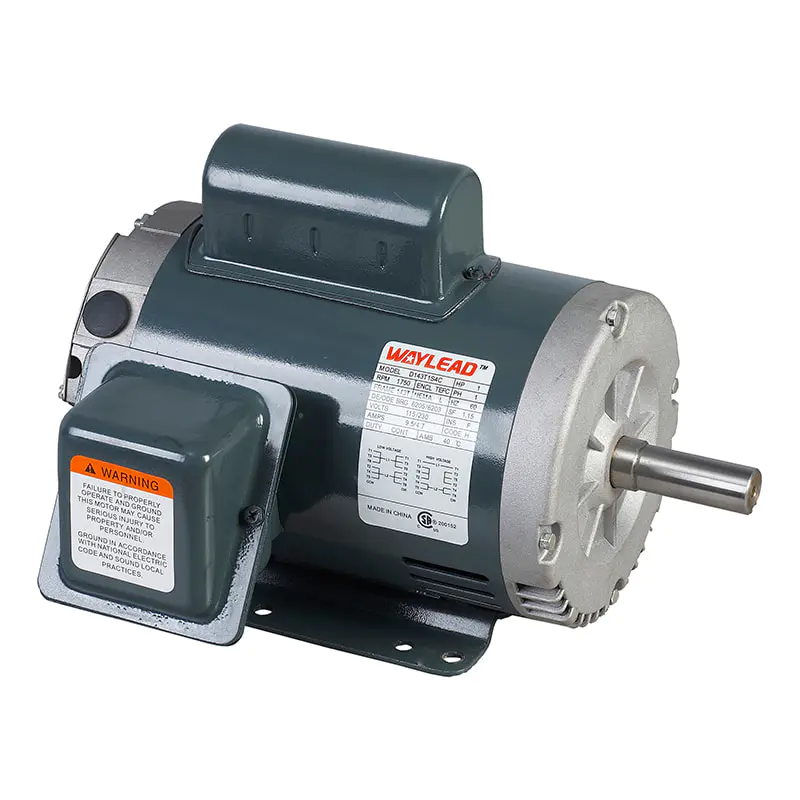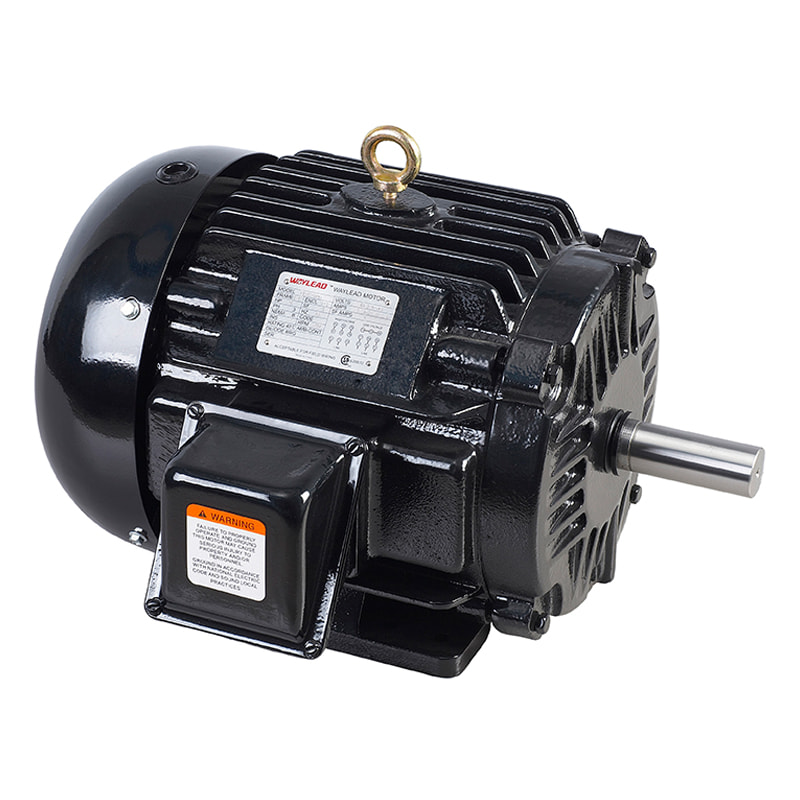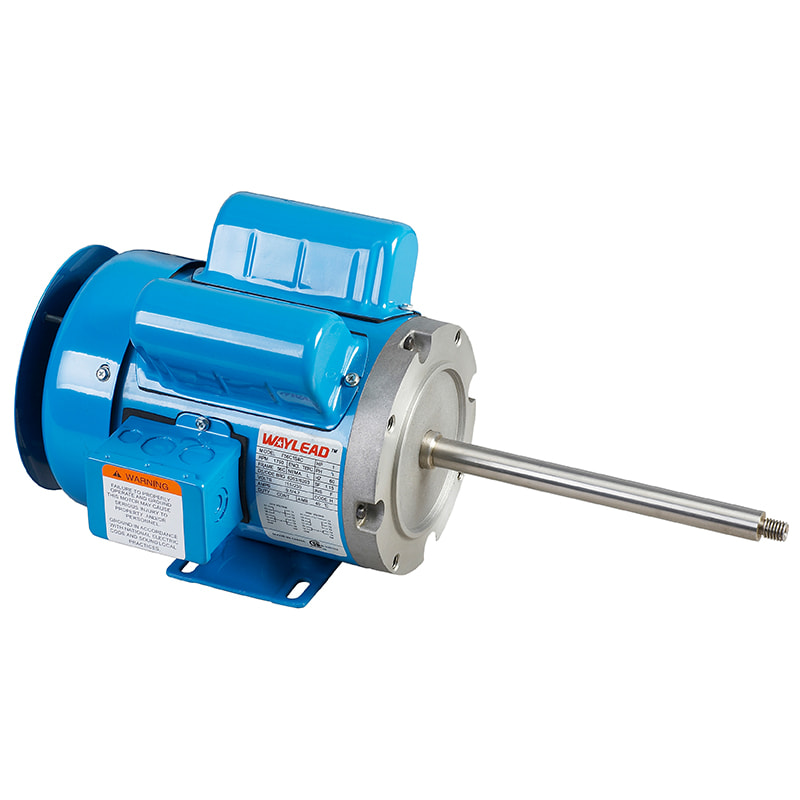
Choosing between a vertical motor, a single phase motor, and a three phase motor is one of the most consequential decisions in industrial equipment selection — and getting it wrong can mean wasted energy, premature failure, and costly downtime. The short answer: vertical motors are defined by their mounting orientation and are used in shaft-down applications like pumps and cooling towers; single phase motors suit low-power residential and light commercial uses; and three phase motors deliver superior efficiency and torque for heavy industrial operations. Understanding the nuances of each, however, requires a closer look at design, performance data, cost, and real-world use cases.
What Is a Vertical Motor and Why Does Orientation Matter?
A vertical motor is not simply a standard motor turned on its side — it is an entirely purpose-engineered machine designed to operate with its shaft pointing downward (or upward in some configurations). The orientation fundamentally changes how internal components handle gravity, lubrication, and thrust loads, making off-the-shelf horizontal motors unsuitable substitutes.
The most critical mechanical difference is the thrust bearing design. In a vertical motor, the rotor assembly — along with the attached pump shaft, impeller, and any fluid column above it — exerts continuous downward thrust. Standard horizontal motor bearings are not engineered to absorb this axial load. Vertical motors therefore incorporate thrust bearings rated for thousands of pounds of downward force, typically using angular contact or tapered roller bearing configurations.
Key Design Features of Vertical Motors
Vertical motors share several specialized design features that distinguish them from their horizontal counterparts:
- Thrust bearing capacity: Engineered to handle both upthrust and downthrust forces, often rated from 500 lbf up to 50,000 lbf in large pump-drive motors.
- Hollow shaft or solid shaft options: Hollow-shaft vertical motors allow the pump shaft to pass through the motor, simplifying coupling and alignment. This is the most common configuration in municipal water and wastewater pump stations.
- NEMA P-base or C-face mounting flanges: Standardized flanges ensure the motor bolts directly onto the pump head, eliminating the need for a separate baseplate or coupling guard.
- IP55 or IP65 enclosure ratings: Because vertical motors are often installed outdoors or in wet pump pits, high-level ingress protection is standard.
- Enhanced ventilation: Cooling air must flow upward against gravity; vertical motors feature redesigned fan assemblies and duct paths to prevent hot spots in the stator.
Typical Applications of Vertical Motors
Vertical motors dominate applications where a vertical shaft is mechanically necessary:
- Deep-well turbine pumps for municipal water supply (power range: 5 HP to 4,000 HP)
- Cooling tower fans and induced-draft fans in HVAC systems
- Vertical inline pump drivers for industrial process loops
- Irrigation pumping stations in agricultural sectors
- Condensate and boiler feed pumps in power generation facilities
Single Phase Motor: The Workhorse of Residential and Light Commercial Settings
A single phase motor runs on single-phase AC power (120V or 240V in North America, 230V in most of Europe) and is the dominant choice for fractional to small integral horsepower applications — typically below 5 HP. Its widespread use stems from the universal availability of single-phase power in homes, farms, and small businesses, not from superior engineering performance.
Unlike three phase motors, a single phase motor cannot self-start from a single-phase supply alone. A single-phase alternating current produces a pulsating — rather than rotating — magnetic field, which provides no net starting torque by itself. Manufacturers solve this with auxiliary starting mechanisms, which give rise to the major subtypes of single phase motors.
Types of Single Phase Motors
- Capacitor-Start Induction-Run (CSIR): Uses a start capacitor (typically 100–400 µF) to create a phase shift in the auxiliary winding, producing enough starting torque (200–350% of full-load torque) for compressors and pumps. The capacitor is disconnected by a centrifugal switch once the motor reaches ~75% of rated speed.
- Capacitor-Start Capacitor-Run (CSCR): Adds a run capacitor to maintain a near-two-phase condition during operation, improving power factor and efficiency by 5–10% compared to CSIR motors. Common in air conditioners and refrigerators.
- Split-Phase (Resistance-Start): The auxiliary winding has higher resistance and lower inductance than the main winding, creating a modest phase displacement. Starting torque is lower (100–175% FLT) and starting current is high (600–800% FLT). Suitable for fans, blowers, and small appliances with easy-starting loads.
- Permanent Split Capacitor (PSC): A single run capacitor remains in circuit at all times. This design produces low starting torque but operates quietly and efficiently, making it the first choice for direct-drive HVAC fan motors and small circulators.
- Shaded Pole Motor: The simplest and least expensive single phase motor; shading coils create a delayed magnetic flux in part of each pole. Very low starting torque and efficiency (15–35%). Used in light-duty applications: small fans, desk fans, appliances.
Three Phase Motor: The Backbone of Industrial Power
The three phase motor is the most efficient, reliable, and cost-effective electric motor type for industrial use. It is self-starting, produces smooth continuous torque, and achieves full-load efficiencies of 92–97% in modern premium-efficiency designs — significantly outperforming single phase motors of the same power rating.
Three-phase AC power delivers three overlapping voltage waveforms, each offset by 120°. When applied to the stator windings of a three phase motor, they produce a continuously rotating magnetic field that induces a rotor current and generates torque — without any auxiliary starting winding, capacitor, or centrifugal switch. This simplicity translates directly to lower manufacturing cost, lower maintenance, and longer service life.
Why Three Phase Motors Dominate Industry
- Higher efficiency: IE3 (Premium Efficiency) and IE4 (Super Premium Efficiency) three phase motors achieve full-load efficiencies above 95% at 30 HP, versus 85–90% for comparable single phase designs.
- Power density: A three phase motor produces 150% more power output per kilogram of copper and iron compared to an equivalent single phase motor.
- Smooth torque delivery: Three-phase power produces constant instantaneous power, eliminating the torque pulsations present in single-phase systems (which peak twice per cycle). This reduces vibration, noise, and mechanical stress on driven equipment.
- Wide power range: Available from fractional HP to 50,000+ HP, making three phase motors suitable for every scale of industrial operation.
- Easy speed control: Variable Frequency Drives (VFDs) pair seamlessly with three phase induction motors, enabling 20–60% energy savings in variable-load applications like pumps, fans, and compressors.
Comprehensive Comparison: Vertical Motor vs. Single Phase Motor vs. Three Phase Motor
The table below provides a direct side-by-side comparison across the most important selection criteria:
| Parameter | Vertical Motor | Single Phase Motor | Three Phase Motor |
|---|---|---|---|
| Mounting Orientation | Vertical (shaft-down or shaft-up) | Horizontal (typically) | Horizontal or vertical |
| Power Supply | 1-phase or 3-phase | Single-phase (120V/240V) | Three-phase (208–690V) |
| Typical Power Range | 1 HP – 4,000 HP | 1/20 HP – 10 HP | 0.25 HP – 50,000+ HP |
| Full-Load Efficiency | 88–96% (3-phase version) | 62–88% | 85–97% |
| Self-Starting | Yes (with 3-phase supply) | No (requires starting aid) | Yes |
| Torque Smoothness | Smooth (3-phase) | Pulsating | Smooth (constant) |
| Thrust Bearing | Specialized heavy-duty | Standard radial | Standard radial |
| VFD Compatibility | Yes (3-phase version) | Limited / not recommended | Excellent |
| Maintenance Complexity | Moderate–High | Low–Moderate | Low |
| Initial Cost (relative) | High | Low | Medium |
| Primary Applications | Deep-well pumps, cooling towers | Appliances, small HVAC, tools | Industry, compressors, conveyors |
Table 1: Side-by-side technical and commercial comparison of vertical motor, single phase motor, and three phase motor across 11 key selection criteria.
Energy Consumption and Total Cost of Ownership: The Numbers Tell the Story
Efficiency differences between motor types translate directly to operating costs. Consider a real-world example: a 5 HP (3.73 kW) pump motor running 6,000 hours per year at an electricity rate of $0.12/kWh.
| Motor Type | Efficiency (%) | Input Power (kW) | Annual Energy (kWh) | Annual Cost (USD) |
|---|---|---|---|---|
| Single Phase Motor (CSIR) | 82% | 4.55 | 27,300 | $3,276 |
| Three Phase Motor (IE2) | 90% | 4.14 | 24,840 | $2,981 |
| Three Phase Motor (IE3) | 93.6% | 3.99 | 23,940 | $2,873 |
Table 2: Annual energy cost comparison for a 5 HP pump motor running 6,000 hours/year at $0.12/kWh. IE3 three phase motor saves $403/year versus a comparable single phase motor.
Over a 10-year service life, switching from a single phase motor to an IE3 three phase motor saves approximately $4,030 in electricity alone — more than the purchase price of many motors in this size range. When scaled to a facility with 50 such motors, the annual savings exceed $20,000.
How to Select the Right Motor: A Practical Decision Framework
The correct motor selection depends on four primary variables: power supply availability, mechanical interface requirements, load characteristics, and total cost of ownership over the intended service life.
Step 1: Assess Available Power Supply
If the installation site has only single-phase power (common in residences, rural farms, and small retail units), a single phase motor is often the only viable option without costly infrastructure upgrades. If three-phase power is available — as it typically is in factories, commercial buildings, and municipal facilities — a three phase motor should be the default choice for any load above 1 HP, delivering better efficiency and lower long-term costs.
Step 2: Determine Shaft Orientation Requirements
If the driven equipment (pump, fan, agitator) requires a vertical shaft, a purpose-built vertical motor is mandatory. Attempting to use a standard horizontal motor in a vertical orientation voids warranties, compromises bearing lubrication, and dramatically shortens service life. The bearing oil bath in a horizontal motor is not calibrated for vertical operation — oil will pool at the bottom and starve the upper bearing.
Step 3: Match Motor to Load Characteristics
- High starting torque loads (compressors, conveyors with heavy loads): Use a three phase motor with Design B or Design C torque characteristics, or a CSIR single phase motor if only single-phase power is available.
- Variable-speed loads (pumps, fans, blowers): A three phase motor paired with a VFD is the optimum solution. Single phase VFDs exist but are less efficient and less reliable.
- Continuous 24/7 operation: Always prioritize IE3 or higher three phase motors; the energy savings justify the premium price within 12–24 months.
- Intermittent duty cycles (small appliances, power tools): A single phase motor is adequate and more economical.
Installation and Maintenance Considerations
Vertical Motor Installation Best Practices
Proper installation of a vertical motor is critical to achieving rated service life. Key steps include:
- Verify that the pump discharge head is rated for the motor's weight and thrust load.
- Check thrust bearing preload settings per the manufacturer's specification sheet before startup.
- Use a calibrated torque wrench on all mounting bolts; uneven flange seating causes vibration and bearing misalignment.
- Grease lubricated bearings should be re-greased at 2,000–4,000-hour intervals; oil-lubricated designs require quarterly oil level checks.
- Perform vibration analysis at commissioning to establish a baseline — any reading above 0.1 in/s (velocity) at the bearing housing warrants investigation.
Single Phase Motor Maintenance Tips
The centrifugal switch and capacitors in a single phase motor are the primary failure points. Maintenance routines should include:
- Inspect centrifugal switch contacts annually for wear and carbon deposits; replace if pitting exceeds 0.5 mm depth.
- Test start and run capacitors with a capacitance meter; replace if capacitance is more than 10% below rated value.
- Monitor operating temperature — a single phase motor running hot (above Class B insulation limit of 130°C) indicates overloading, poor ventilation, or a failing capacitor.
Three Phase Motor Maintenance Tips
The inherent simplicity of a three phase motor means maintenance is primarily preventive:
- Perform insulation resistance (megger) tests annually; a healthy motor should read above 100 MΩ at 1,000V DC.
- Check phase balance at the motor terminals — voltage imbalance exceeding 1% causes a disproportionate 6–10% increase in motor heating.
- Lubricate bearings per manufacturer schedules; over-greasing is as damaging as under-greasing.
- Monitor motor current with a clamp meter at each service interval; a gradual current increase often signals bearing wear or winding degradation before complete failure.
Frequently Asked Questions (FAQ)
Q1: Can a vertical motor be used horizontally?
No. A vertical motor should never be operated in a horizontal position. Its bearing system, lubrication reservoirs, and cooling airflow are all designed for vertical operation. Running it horizontally will cause rapid bearing failure, oil leaks, and overheating within hours or days of operation.
Q2: Can a single phase motor be converted to run on three phase power?
Not directly. A single phase motor has windings designed for one phase. However, a phase converter (rotary or static) can generate three-phase power from a single-phase supply, allowing a three phase motor to operate where only single-phase power is available — a more practical solution than the reverse.
Q3: Why do three phase motors last longer than single phase motors?
Three phase motors have no capacitors, starting switches, or auxiliary windings — the components that most commonly fail in single phase motors. The smooth, continuous torque also reduces mechanical stress on bearings and windings. A well-maintained three phase motor can reliably operate for 20–30 years, versus 10–15 years for a comparable single phase unit under similar conditions.
Q4: What does "hollow shaft" mean in a vertical motor?
A hollow-shaft vertical motor has a tubular rotor shaft with an open center bore that allows the pump column shaft to pass entirely through the motor. The pump shaft is secured to the motor rotor via an adjustable head nut at the top of the motor, eliminating the need for an external shaft coupling. This design simplifies alignment and reduces the overall height of the pump-motor assembly.
Q5: Is a single phase motor suitable for a well pump?
For shallow-well jet pumps and small submersibles (under 1.5 HP), a single phase motor is commonly used and perfectly adequate. For deep-well turbine pumps requiring more than 5 HP — or for any pump in a commercial or municipal setting — a vertical motor with a three phase motor drive system is strongly recommended for reliability and energy efficiency.
Q6: What is the service factor in motor specifications, and does it differ between motor types?
Service factor (SF) is a multiplier indicating how much above the nameplate power a motor can operate continuously without damage. Most single phase motors carry an SF of 1.25–1.35, while standard three phase motors are typically rated SF 1.15. Vertical motors for pump service are generally specified at SF 1.0 to 1.15, because their thrust bearings are sized precisely for the rated load and leave less mechanical margin.
Conclusion: Match the Motor to the Mission
There is no universally "best" motor — only the right motor for a specific application. A vertical motor is the only correct choice when a vertical shaft interface is required; no amount of engineering workarounds makes a horizontal motor a safe substitute. A single phase motor remains the practical and cost-effective solution for low-power applications wherever only single-phase power is available. And a three phase motor is the optimal choice for virtually every industrial, commercial, and heavy-duty application where three-phase power is accessible — offering superior efficiency, longevity, smooth torque, and seamless VFD integration.
The data is clear: over a 10-year operating horizon, the higher upfront cost of a premium-efficiency three phase motor is recovered many times over in energy savings. For facilities looking to reduce operating costs and carbon footprint simultaneously, upgrading aging single phase motors to IE3 three phase motors — where the power infrastructure allows — is one of the highest-ROI investments available in industrial energy management.