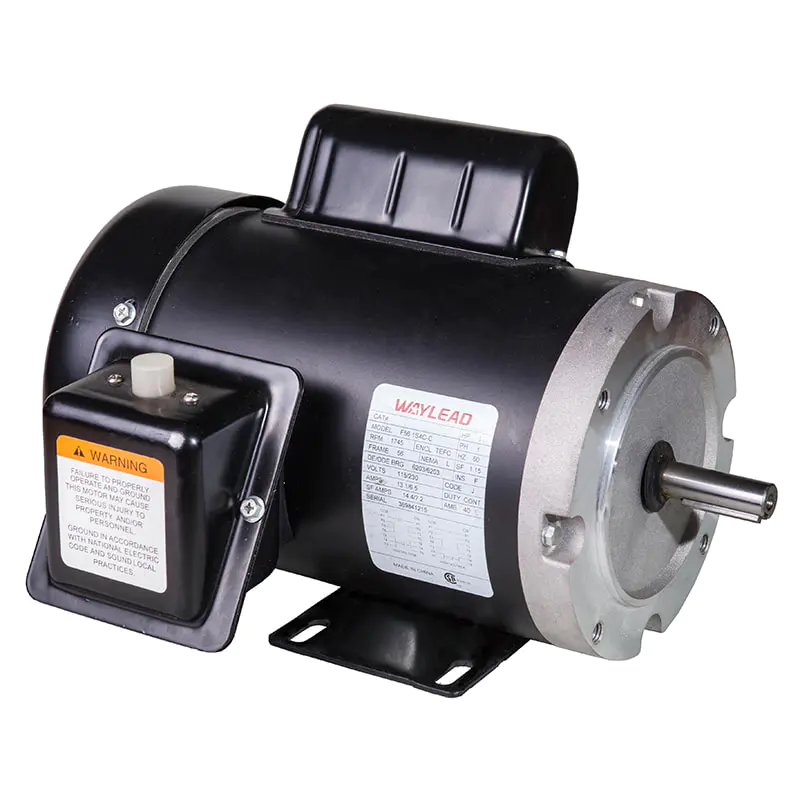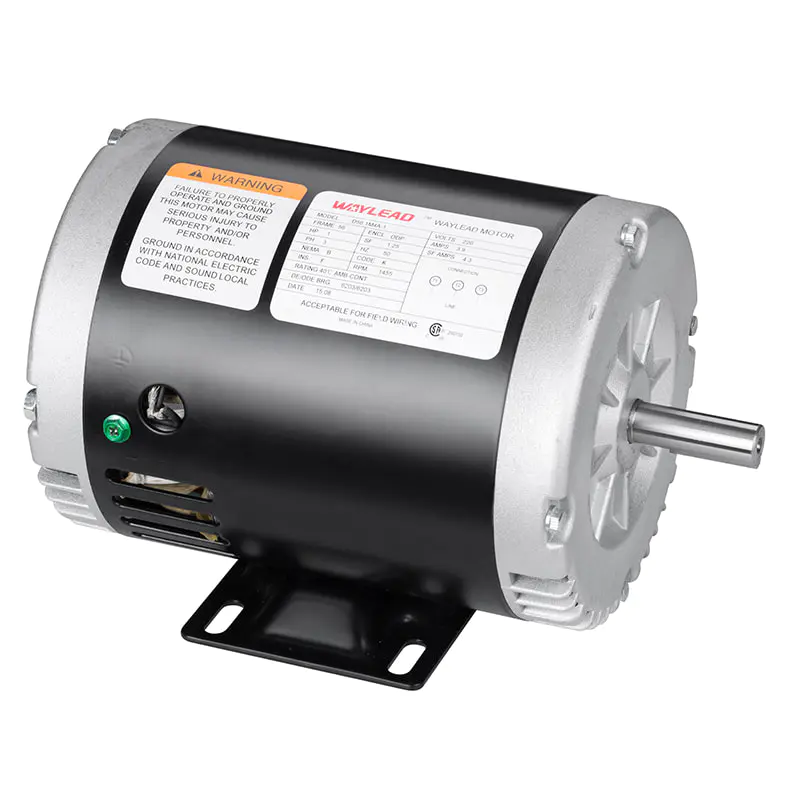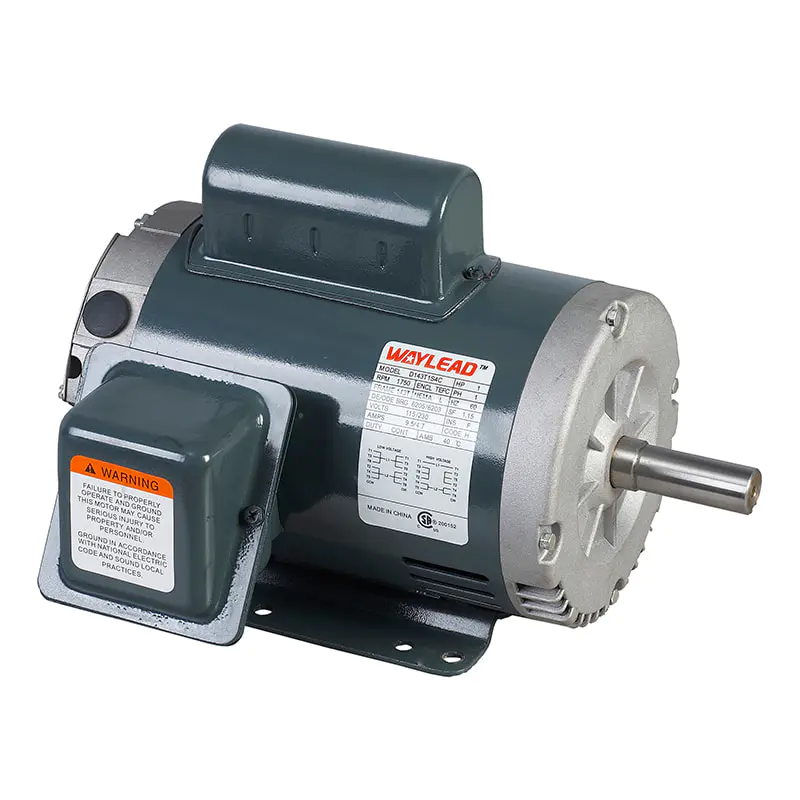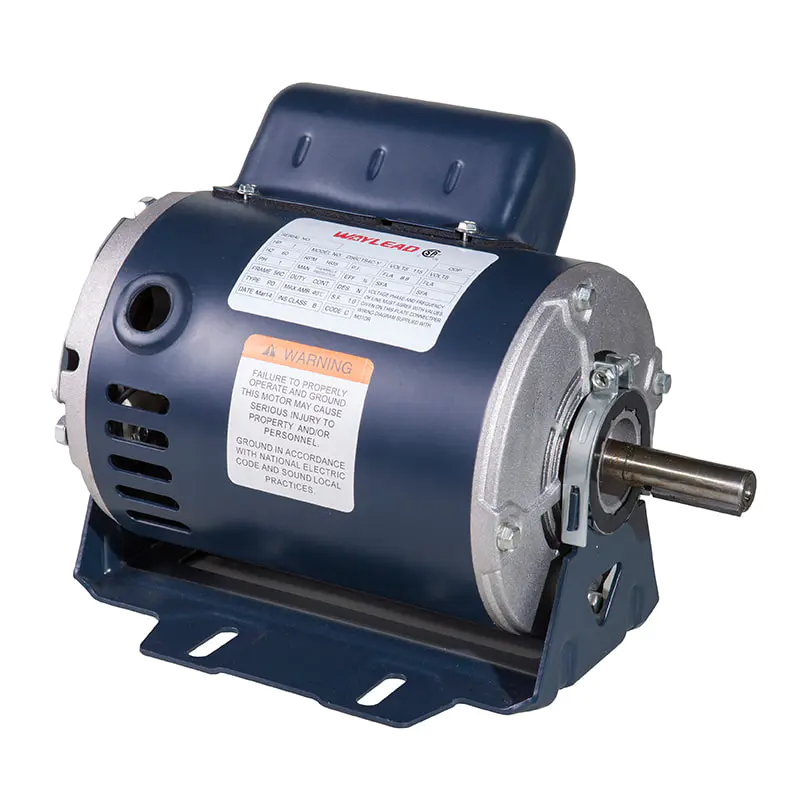
A single phase electric motor is an electromechanical machine that converts single-phase alternating current (AC) electricity into mechanical rotation, typically delivering power outputs from fractional horsepower up to approximately 5 kW. Unlike three-phase motors, a single phase electric motor cannot produce a rotating magnetic field from a single winding alone; it requires an auxiliary starting circuit—such as a capacitor, shaded pole, or split-phase winding—to generate the initial torque. According to the International Energy Agency's 2024 Motor Systems Report, single-phase motors account for over 78% of all electric motors produced globally by unit volume, primarily because they match the residential and light commercial power grid where only single-phase supply is available. The U.S. Department of Energy further notes that these motors consume roughly 45% of the electricity used in residential and commercial HVAC, water pumping, and appliance applications, making an understanding of their types and efficiency critical for any technical buyer or maintenance professional.
How a Single Phase Electric Motor Works: The Starting Challenge Solved
The definitive engineering truth is that a single phase electric motor requires a secondary magnetic field, shifted in phase, to create the rotational torque needed to move the rotor from a standstill. When single-phase AC flows through the main stator winding, it produces a pulsating magnetic field that oscillates along one axis rather than rotating. This field can be mathematically decomposed into two counter-rotating fields, which cancel each other's torque at zero speed. The solution, as documented in IEEE Standard 112 for polyphase and single-phase induction motors, is to add an auxiliary winding physically displaced from the main winding by 90 electrical degrees, supplied with current that is phase-shifted by a capacitor, resistor, or the winding's own higher reactance. Once the rotor reaches about 70-80% of synchronous speed, a centrifugal switch disconnects the start winding in most designs, and the motor continues to run on the main winding alone. The table below summarizes the starting methods that define each single phase electric motor type.
| Starting Method | Phase-Shift Element | Typical Starting Torque (% of full load) | Common Power Range | Representative Application |
|---|---|---|---|---|
| Split-Phase | Resistance of auxiliary winding | 150–200% | 0.05–0.5 kW | Small fans, blowers, office machines |
| Capacitor Start | Electrolytic capacitor | 300–450% | 0.25–3.7 kW | Air compressors, water pumps, conveyors |
| Capacitor Run (PSC) | Oil-filled capacitor (always in circuit) | 50–100% | 0.05–2.2 kW | Ceiling fans, condenser fan motors, direct-drive blowers |
| Capacitor Start-Run | Two capacitors (start + run) | 300–450% | 0.5–5 kW | Industrial pumps, woodworking machines, large compressors |
| Shaded Pole | Copper shading ring | 30–60% | 0.002–0.25 kW | Small desk fans, bathroom exhaust fans, refrigerator evaporator fans |
Table: Comparison of starting methods and performance characteristics for the five primary types of single phase electric motors, as classified by NEMA MG 1 and IEC 60034-30-1 standards.
What Are the Main Types of Single Phase Electric Motors and Where Are They Applied
The practical answer is that the five primary types of single phase electric motor designs each serve a distinct torque, efficiency, and cost niche, and selecting the wrong type leads to premature failure or wasted energy. The split-phase motor is the simplest and most economical for light starting loads, while the capacitor-start version delivers the high starting torque needed for piston compressors and pumps. Capacitor-run or permanent split capacitor (PSC) motors sacrifice starting torque for quieter operation and higher running efficiency, making them the standard in HVAC fans and blowers. Capacitor start-run motors combine both advantages for the most demanding applications, and shaded-pole motors remain in production solely for ultra-low-cost, low-power devices. The following ordered list guides you through the decision logic when matching a motor type to a specific task.
- Identify the required starting torque. If the load is hard to start (e.g., a reciprocating compressor), a single phase electric motor with capacitor start is mandatory. For a fan that starts easily, a PSC or shaded-pole unit suffices.
- Determine the duty cycle. Continuous duty (S1) applications need a capacitor-run motor that can sustain rated load without overheating. Intermittent duty (S2 or S3) can tolerate the lower thermal capacity of split-phase designs.
- Evaluate the power supply quality. In areas with frequent voltage sags, a capacitor-start single phase electric motor with a higher breakdown torque rating (typically above 250% of full-load torque) provides better stall resistance.
- Check efficiency regulations. For any motor above 0.75 kW sold in the U.S. or European Union, an IE2 or IE3 efficiency class is legally required under the DOE small motor rule and the EU Ecodesign Regulation (EU) 2019/1781, effectively mandating a capacitor-based design over a split-phase or shaded-pole type.
Key Internal Components That Determine Reliability and Performance
Every single phase electric motor shares a core architecture of a stationary stator, a rotating squirrel-cage rotor, and a set of bearings, but the longevity differentiation comes from the quality of the auxiliary components—specifically the capacitor, centrifugal switch, and insulation system. The stator core, built from laminated silicon steel (typically 0.35–0.65 mm thick per lamination), carries the main and auxiliary windings embedded in slots. The rotor consists of aluminum or copper bars shorted at both ends by end rings, forming a cage that induces current when exposed to the stator's pulsating field. The centrifugal switch, present in split-phase and capacitor-start motors, opens the start winding circuit at 70–80% of synchronous speed; its failure is the most common repair cause, reported in 32% of motor service calls according to the Electrical Apparatus Service Association (EASA) 2023 field failure survey. In capacitor-run motors, the oil-filled run capacitor remains permanently connected and helps improve the power factor from around 0.55–0.65 to above 0.85, which directly lowers the current draw and line losses.
Single Phase vs. Three Phase Electric Motors: A Quantitative Comparison
A single phase electric motor is inherently less efficient and larger in frame size than an equivalent-power three-phase motor because the single-phase supply does not generate a smooth, continuous torque profile. The table below provides the key numerical contrasts based on NEMA MG 1 design values for 1.5 kW, 1800 RPM, TEFC enclosures.
| Parameter | Single Phase Electric Motor (Capacitor Start-Run) | Three Phase Squirrel Cage Motor |
|---|---|---|
| Full-load efficiency (1.5 kW) | 78–84% | 86–91% |
| Power factor at full load | 0.80–0.95 | 0.82–0.88 |
| Starting current (× full-load current) | 5–7 | 6–8 |
| Weight (same output) | Approximately 30–50% heavier | Lighter, more compact |
| Maximum practical power | 5–7.5 kW | Up to several megawatts |
| Relative purchase cost | 1.5–2.5× higher per kW | Lower per kW |
Table: Quantitative comparison between a typical 1.5 kW single phase electric motor and its three-phase counterpart, based on NEMA MG 1-2021 performance data and DOE Motor Market Assessment 2023.
Efficiency Standards and Energy-Saving Potential of Modern Single Phase Electric Motors
Upgrading an old, standard-efficiency single phase electric motor to a modern IE3 or IE4 unit cuts electricity consumption by 10% to 20%, a saving that typically repays the motor purchase price within 12 to 24 months in continuous-duty applications. The U.S. Department of Energy's Small Electric Motor Rule, effective since March 2020, mandates that single-phase motors from 0.25 to 3 horsepower meet at least the NEMA Premium efficiency level, which aligns with the IE3 class defined in IEC 60034-30-1. For a 1.5 kW motor running 6,000 hours per year at an electricity rate of $0.12/kWh, the difference between an IE1 efficiency of 74% and an IE3 efficiency of 84% translates to an annual energy saving of approximately 1,500 kWh, or $180. At a global scale, the International Copper Association estimates that upgrading the installed base of fractional-horsepower single phase electric motors to IE3 could reduce worldwide CO2 emissions by 180 million metric tons annually by 2030, which is equivalent to removing 40 million passenger vehicles from the road. These numbers make efficiency grade one of the highest-priority specifications when procuring or replacing a motor.
Practical Selection Guide: How to Choose the Right Single Phase Electric Motor
The most effective approach to selecting a single phase electric motor is to match the motor's service factor, enclosure type, and mounting frame to the specific mechanical load and environment, rather than simply matching the horsepower. Follow these steps for a durable, code-compliant installation.
- Calculate the true mechanical load. Measure the driven machine's torque requirement at the shaft, not just the nameplate power, because a single phase electric motor must handle the peak load without stalling. Oversizing by a 1.15 service factor is standard for pumps and fans; use a 1.25 factor for compressors and conveyors subject to intermittent overloads.
- Confirm the available voltage and frequency. Common nominal voltages are 115 V, 208 V, or 230 V at 60 Hz in North America, and 230 V at 50 Hz in most other regions. A single phase electric motor designed for 60 Hz will run slower and draw more current at 50 Hz, risking overheating if not specifically rated for dual-frequency use.
- Select the appropriate enclosure. Open drip-proof (ODP) enclosures work indoors in clean, dry air. For outdoor or wet locations, a totally enclosed fan-cooled (TEFC) motor is mandatory; TEFC units account for 68% of all single-phase motor sales in industrial distribution, per the Power Transmission Distributors Association 2024 market report.
- Verify the mounting configuration. NEMA frame sizes 48, 56, and 143T/145T cover the vast majority of small single phase electric motor applications. Match the frame to the existing equipment's bolt pattern, shaft diameter, and shaft height to avoid expensive adapter plates.
- Consider integrated controls. For fans and pumps subject to variable flow demands, a single phase electric motor with an integrated variable speed drive (VSD) can reduce energy use by 25–50% compared to on-off cycling or mechanical throttling, as documented in case studies by the American Council for an Energy-Efficient Economy (ACEEE).
Frequently Asked Questions About Single Phase Electric Motors
Why does a single phase electric motor need a capacitor to start?
A single phase electric motor needs a capacitor in its auxiliary winding to create a phase-shifted current that generates a rotating magnetic field. Without this phase shift, the field simply pulses back and forth, producing zero net starting torque. The capacitor provides a leading current in the auxiliary winding, which, combined with the lagging current in the main winding, approximates the two-phase supply needed to spin the rotor from standstill. Once the motor reaches speed, the capacitor is either disconnected by a centrifugal switch or remains in circuit to improve running power factor.
Can I run a single phase electric motor on a three-phase supply?
No, a single phase electric motor cannot be directly connected to a three-phase supply; it requires a single phase-to-neutral or phase-to-phase voltage that matches its nameplate rating. Connecting it across two phases of a three-phase system delivers the correct voltage magnitude in many 208V or 480V systems, but the motor still sees a single-phase supply—the voltage between any two phases is still single-phase with respect to the motor's terminals. However, the motor's internal design expects a true single-phase source, and no modification can make it run on a balanced three-phase input without a phase converter.
How do I reverse the rotation of a single phase electric motor?
Reversing the rotation of a single phase electric motor requires swapping the polarity of either the main winding or the start winding relative to the other, but never both. In a capacitor-start motor, this is typically done by interchanging the leads of the start winding at the terminal board. In a PSC motor, swapping the capacitor from being in series with one winding to the other achieves reversal. Shaded-pole motors cannot be reversed electrically; their rotation is fixed by the physical position of the shading ring.
What causes a single phase electric motor to hum but not start?
A humming single phase electric motor that fails to rotate almost always indicates a failed start capacitor, a stuck centrifugal switch, or a seized rotor bearing. The hum is the main winding drawing current and creating a pulsating field without the auxiliary winding's contribution. According to EASA repair data, a defective capacitor accounts for 60% of such failures, and a simple capacitance test with a multimeter that reads microfarads can confirm whether the capacitor is open, shorted, or has drifted beyond its tolerance band.
Is a single phase electric motor more expensive to operate than a three-phase motor?
Yes, a single phase electric motor of the same horsepower typically costs 15–30% more to operate in electricity because its efficiency is 5–10 percentage points lower. However, the total cost of ownership may still favor a single-phase solution if bringing a three-phase supply to the site requires expensive utility upgrades. A life-cycle cost analysis that includes installation, cable sizing, and switchgear often demonstrates that for motors below 3 kW, the single-phase option is economically rational despite the efficiency penalty.
The Single Phase Electric Motor as a Cornerstone of Modern Convenience
Understanding exactly what a single phase electric motor is—and how its starting mechanism, efficiency grade, and enclosure type combine to determine real-world performance—empowers engineers, facility managers, and equipment buyers to make decisions that improve reliability and lower operating cost. From the shaded-pole fan that ventilates a bathroom to the capacitor start-run motor that drives a workshop air compressor, these motors remain the invisible workforce behind daily life. By prioritizing IE3 efficiency, matching the starting torque to the load, and adhering to the selection sequence described above, any organization can extract the maximum value from its single-phase motor investment while meeting tightening energy regulations worldwide.