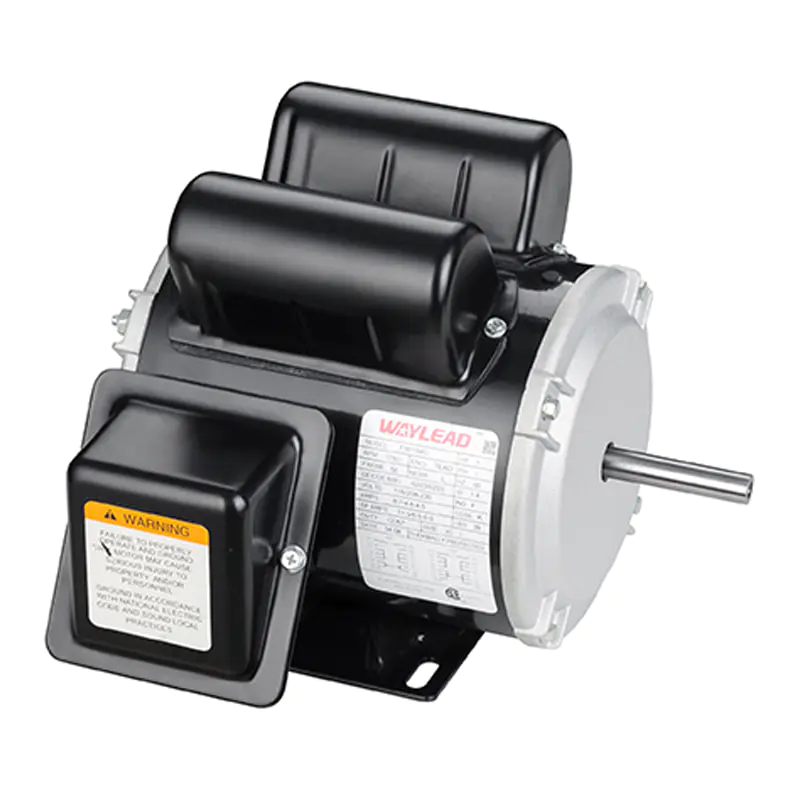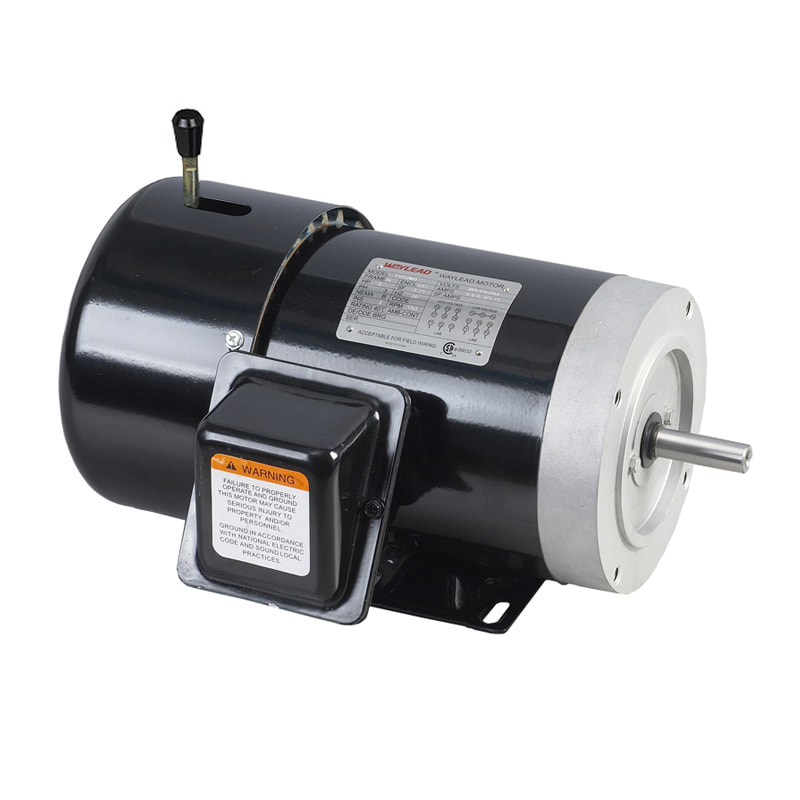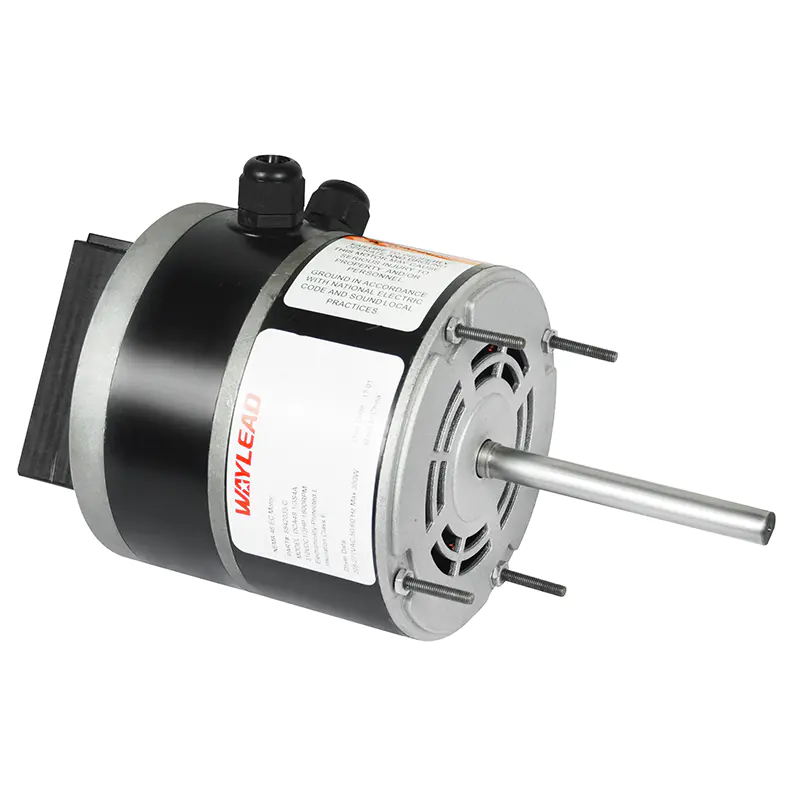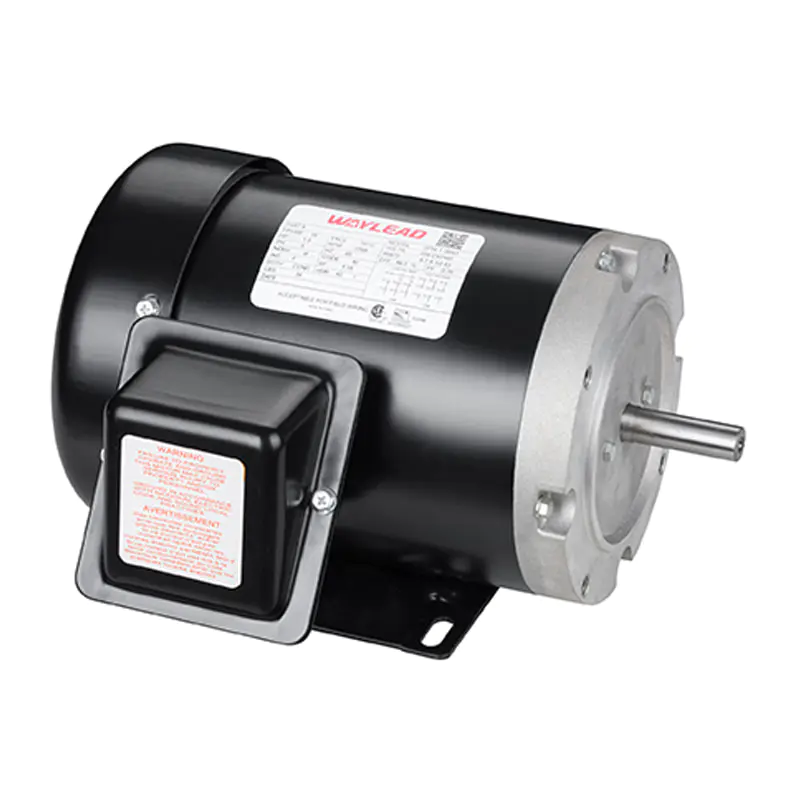
Single phase motors have capacitors because a single phase power supply cannot generate a rotating magnetic field on its own — the capacitor creates an artificial second phase by shifting the current in an auxiliary winding by approximately 90 degrees, producing the phase difference needed to generate starting torque and sustain rotation. Without a capacitor, a single phase induction motor has zero starting torque and will not self-start under any load condition.
This is one of the most fundamental questions in electrical engineering and motor maintenance. Understanding why single phase motors need capacitors — and exactly what the capacitor does inside the motor — is essential knowledge for technicians, engineers, and anyone responsible for maintaining HVAC systems, pumps, compressors, fans, and other single phase motor-driven equipment.
A single phase induction motor cannot self-start because its single-phase supply produces a pulsating magnetic field that alternates back and forth along one axis, rather than rotating around the stator — and without a rotating field, the rotor experiences no net directional torque.
In a three phase motor, the three current waveforms are naturally separated by 120 degrees in time. This produces a smoothly rotating magnetic field inside the stator that induces torque in the rotor and drives it to follow the field. The self-starting capability of three phase motors requires no additional components.
In a single phase motor, there is only one winding energized by one alternating current waveform. The magnetic field produced by this winding oscillates — it grows, collapses, reverses, and grows again — but it does not rotate. It can be mathematically decomposed into two equal counter-rotating magnetic fields. These two counter-rotating components cancel each other out in terms of net torque on a stationary rotor, which is why the motor produces exactly zero starting torque when the rotor is at rest.
Once the rotor is spinning (by any external means), it locks onto one of the two rotating components and continues to run. This is why you can sometimes start a single phase motor by giving the shaft a manual spin — but this approach is dangerous, unreliable, and impractical for real applications. The capacitor solves this problem permanently and safely.
The capacitor solves the single phase starting problem by introducing a time-phase shift between the current in the main winding and the current in an auxiliary (start) winding, creating two out-of-phase magnetic fields that combine to produce a resultant rotating magnetic field capable of generating starting torque.
Here is how the mechanism works step by step:
The quality of the rotating field — and therefore the starting torque — depends on how close the phase shift is to 90 degrees and how well-matched the two winding currents are in magnitude. A properly sized capacitor for a given motor can achieve a phase shift of 80 to 90 degrees, producing a near-ideal rotating field and starting torques ranging from 100% to 350% of full-load torque depending on motor design.
Single phase motors use two distinct types of capacitors — start capacitors and run capacitors — each designed for different electrical conditions and serving different roles in the motor's operation.
Start capacitors are designed for short-duration, high-capacitance duty. They are connected in series with the auxiliary winding only during the starting period — typically less than 3 seconds — and are then disconnected by a centrifugal switch or start relay once the motor reaches approximately 75–80% of synchronous speed.
Start capacitors typically have capacitance values ranging from 70 microfarads (µF) to 1,200 µF and voltage ratings of 110–330 VAC. They use an electrolytic construction that allows high capacitance in a compact package, but this construction cannot withstand continuous energization — overheating and failure occurs within seconds if the start capacitor is not disconnected after starting.
Run capacitors are designed for continuous, steady-state operation and remain in circuit for the entire time the motor is running. They use oil-filled or dry film (polypropylene film) construction, which provides far greater thermal stability than electrolytic capacitors but limits capacitance to a lower range — typically 2 µF to 70 µF — at voltage ratings of 370 VAC or 440 VAC.
Run capacitors serve a dual purpose: they maintain a continuous phase shift in the auxiliary winding to sustain the rotating field during operation, and they improve the motor's power factor, efficiency, and torque smoothness. A properly sized run capacitor can improve motor efficiency by 10–20% compared to a motor running without one.
| Feature | Start Capacitor | Run Capacitor |
| Typical capacitance range | 70 µF to 1,200 µF | 2 µF to 70 µF |
| Voltage rating | 110–330 VAC | 370 VAC or 440 VAC |
| Construction type | Electrolytic | Oil-filled or dry film |
| Duration in circuit | Less than 3 seconds per start | Continuous during operation |
| Primary purpose | High starting torque | Efficiency and torque smoothness |
| Disconnection method | Centrifugal switch or start relay | Always connected |
| Failure mode if left energized | Overheats and fails within seconds | Designed for continuous duty |
Table 1: Comparison of start capacitors and run capacitors used in single phase motors, covering key electrical and operational differences.
There are three main types of single phase motors that use capacitors: capacitor-start motors, capacitor-run motors, and capacitor-start capacitor-run (CSCR) motors — each offering different combinations of starting torque, running efficiency, and application suitability.
Capacitor-start motors use a start capacitor in series with the auxiliary winding during starting. Once the motor reaches approximately 75% of full speed, a centrifugal switch disconnects both the start capacitor and the auxiliary winding. The motor then runs on the main winding alone. These motors deliver starting torques of 200–350% of full-load torque and are commonly used in compressors, pumps, and equipment with high starting load requirements.
Permanent split capacitor (PSC) motors use a single run capacitor that stays in circuit permanently — there is no start capacitor and no centrifugal switch. This design sacrifices some starting torque (typically 30–150% of full-load torque) in exchange for higher running efficiency, quieter operation, and greater reliability due to the elimination of the centrifugal switch. PSC motors dominate HVAC fan applications, small pumps, and equipment that starts unloaded.
CSCR motors use both a start capacitor (for high starting torque) and a run capacitor (for efficient running). The start capacitor is switched out after starting, leaving the run capacitor in circuit permanently. This combination delivers the best of both worlds: starting torques of 300–400% of full-load torque and running efficiency comparable to a PSC motor. CSCR motors are used in hard-starting applications such as air compressors, refrigeration compressors, and heavy-duty pumps.
| Motor Type | Capacitor Used | Starting Torque | Running Efficiency | Typical Applications |
| Capacitor-Start | Start only | 200–350% FLT | Moderate | Pumps, compressors, conveyors |
| PSC (Capacitor-Run) | Run only | 30–150% FLT | High | HVAC fans, small pumps, blowers |
| CSCR | Start and Run | 300–400% FLT | High | Air compressors, refrigeration |
| Split-Phase (no capacitor) | None | 100–175% FLT | Low | Light loads, small appliances |
Table 2: Comparison of single phase motor types by capacitor configuration, starting torque, running efficiency, and typical application. FLT = Full Load Torque.
When a capacitor fails in a single phase motor, the motor either fails to start entirely, starts slowly with a humming noise, runs hot and draws excessive current, or operates with significantly reduced torque — depending on whether the failed component is the start capacitor or the run capacitor.
The most reliable method to test a capacitor on a single phase motor is to use a digital multimeter with a capacitance measurement function (microfarad mode) and compare the reading to the value printed on the capacitor label — a healthy capacitor should read within plus or minus 6% of its rated capacitance.
When replacing a capacitor on a single phase motor, match three parameters exactly: capacitance in microfarads, voltage rating, and capacitor type (start or run) — never substitute a run capacitor for a start capacitor or vice versa, and never use a voltage rating lower than the original.
A single phase motor with a failed run capacitor may continue to run (on the main winding only) but with significantly degraded performance — higher current draw, lower torque, and increased heat. A motor that relies on a start capacitor for starting will not start at all if the start capacitor has failed, though it may run if manually spun. Operating a motor with a missing or failed capacitor accelerates winding damage and shortens motor life dramatically.
A humming single phase motor that fails to start is one of the clearest symptoms of a failed start capacitor. The main winding is energized (producing the hum) but without the phase-shifted auxiliary winding current, there is insufficient starting torque to overcome static inertia. Other possible causes include a seized bearing, a mechanical jam in the load, or a stuck centrifugal switch. Check the capacitor first — it is the most common and easiest-to-fix cause.
Not necessarily. Each motor is designed for a specific capacitance value that produces the optimal phase shift for that winding configuration. Using a capacitor significantly larger than specified can cause overcurrent in the auxiliary winding, excess heat, reduced efficiency, and even motor damage. Always use the capacitance value specified by the motor manufacturer. Oversizing a run capacitor by more than 10–15% above rated value is generally inadvisable without engineering guidance.
Run capacitors typically last 10 to 20 years under normal operating conditions, though heat is the primary enemy of capacitor life — for every 10°C increase in operating temperature above rated limits, capacitor life is roughly halved (Arrhenius Law). Start capacitors, due to their electrolytic construction and high-stress duty cycle, typically have shorter service lives of 5 to 10 years. High-cycle applications (motors that start and stop many times per day) accelerate start capacitor wear significantly.
Some single phase motors use alternative starting methods that do not require a capacitor. Split-phase (resistance-start) motors use a high-resistance auxiliary winding to create a modest phase shift — enough for light starting loads — without a capacitor. Shaded-pole motors, used in small fans and appliances, use a copper shading ring around part of each stator pole to create a slight phase displacement and a weakly rotating field, also without a capacitor. Both types sacrifice starting torque and efficiency compared to capacitor-based designs.
Yes — a motor capacitor can retain a dangerous electrical charge even after the motor is switched off and power is disconnected. Run capacitors can retain charge for several minutes; start capacitors can hold charge for even longer. Always discharge a capacitor through a resistor before handling it, and never short the terminals directly. Treat every disconnected capacitor as potentially energized until it has been properly discharged and verified safe with a voltmeter.
No. Three phase motors do not need capacitors because the three-phase power supply inherently provides the 120-degree phase separation between windings necessary to produce a rotating magnetic field. Three phase motors are self-starting with no auxiliary components required. The need for capacitors is specific to single phase motors as a consequence of the fundamental limitation of single-phase power in generating a rotating stator field.
The answer to why single phase motors have capacitors comes down to a fundamental limitation of single-phase electricity: it cannot naturally produce the rotating magnetic field required to start and efficiently drive an induction motor. The capacitor — whether a start type, a run type, or both — bridges this gap by creating the electrical phase shift that transforms a pulsating field into a rotating one, enabling the motor to develop starting torque and operate efficiently.
Understanding the role of capacitors in single phase motors is not just academic knowledge — it is directly applicable to troubleshooting motor failures, selecting correct replacement components, and making informed decisions about motor maintenance and replacement. A capacitor is a low-cost component, but its correct specification, condition, and installation are critical to the reliable operation of the motor it serves.
Whether you are maintaining HVAC equipment, industrial pumps, air compressors, or any other single phase motor-driven machinery, keeping the capacitor in good condition — and knowing the signs of failure — is one of the highest-value preventive maintenance actions you can take to extend equipment life and avoid costly downtime.
Copyright © 2018 Cixi Waylead Motor Manufacturing Co., Ltd.All Rights Reserved.
 Login
Wholesale AC Motor Manufacturers
Login
Wholesale AC Motor Manufacturers