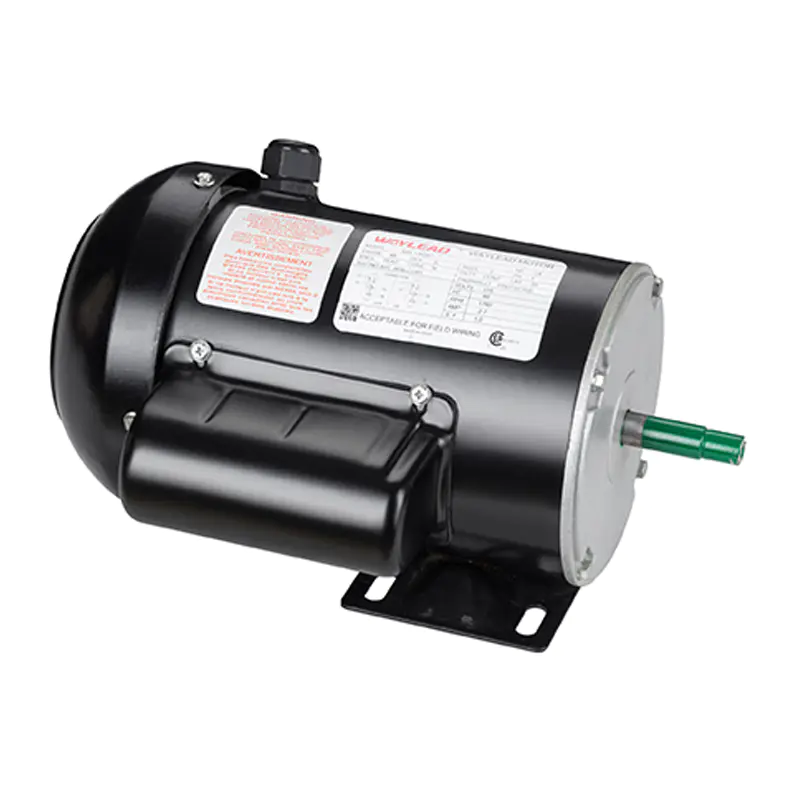
An alternating current electric motor is a machine that converts alternating current (AC) into rotary mechanical motion. A rotating magnetic field inside the stator drags the rotor around, and the output shaft drives pumps, fans, compressors, conveyors, and countless other machines. AC motors dominate industry because they are simple, rugged, and economical, and they run for decades with little maintenance.
How an Alternating Current Motor Works
Every AC motor creates torque the same way: a rotating magnetic field in the stator pulls the rotor along with it. In a three-phase motor, the stator windings are spaced 120 degrees apart, and the currents peak one after another, so the field sweeps continuously around the air gap at synchronous speed. That speed is set by supply frequency and pole count: Ns = 120f/P. A four-pole motor on a 60 Hz supply therefore has a synchronous speed of 1,800 rpm, while the same motor on 50 Hz runs at 1,500 rpm.
Rotor behaviour splits AC motors into two families. In an induction (asynchronous) motor, the rotor contains conducting bars and receives no external power. The rotating stator field induces currents in those bars, and the rotor chases the field but never catches it. The speed lag, called slip, is normally 2-5% at full load and is exactly what produces torque. In a synchronous motor, by contrast, the rotor locks to the rotating field and runs at precisely synchronous speed, which matters when constant speed is essential.
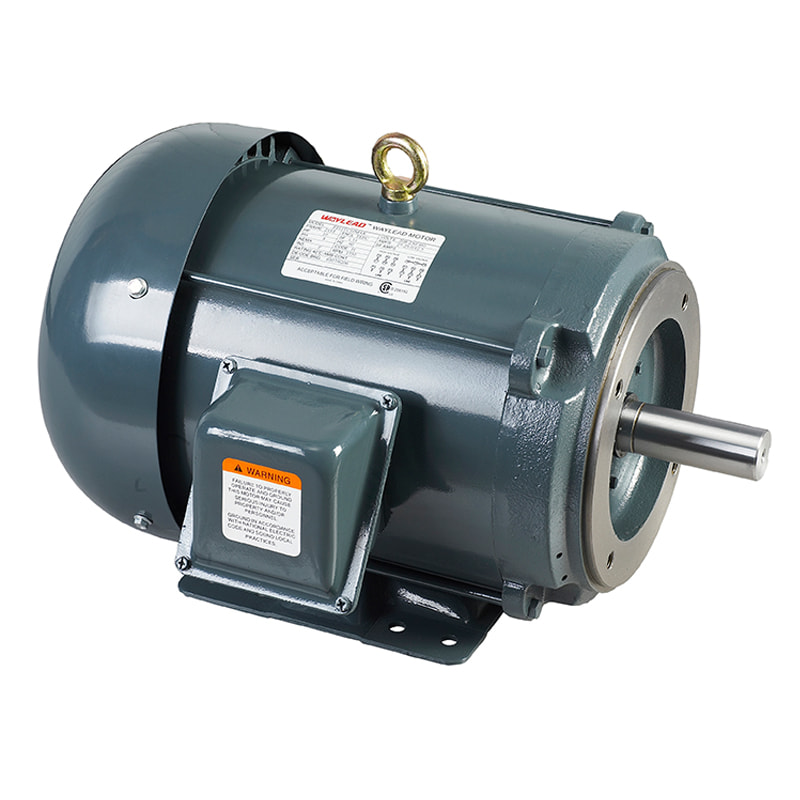
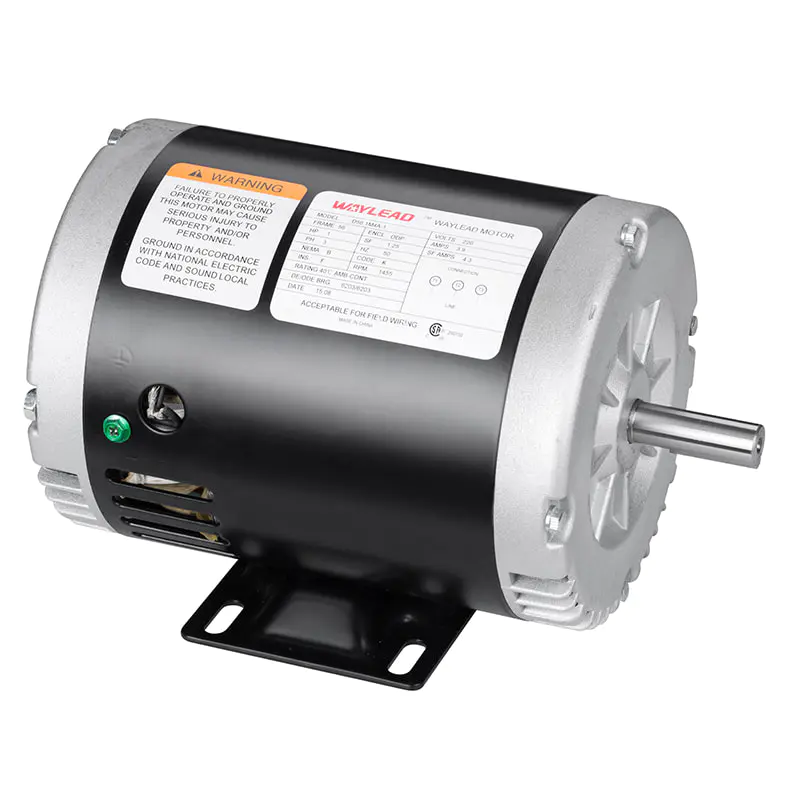 Three-Phase Fractional Horsepower Premium Efficiency MotorThis three-phase induction motor suits industrial loads above 1 hp with its premium efficiency rating and 1.15 service factor. CSA and UL certifications support reliable operation in demanding applications listed earlier.View Product →
Main Types of Alternating Current Motors
For selection, AC motors divide first by supply — single-phase or three-phase — and then by principle — induction or synchronous. Three-phase induction motors are the default for industrial loads from about 1 hp upward because they are self-starting, efficient, and compact. Single-phase induction motors serve homes, farms, and small commercial shops where only a single-phase supply exists. Because a single-phase field pulsates rather than rotates, these motors need a starting aid such as a start capacitor, a run capacitor, or a shaded pole; capacitor-start and two-capacitor designs provide higher starting torque for hard loads.
| Property | Single-phase | Three-phase |
|---|---|---|
| Typical supply | 115 V or 230 V, 50/60 Hz | 208 V, 230 V, 460 V, 575 V |
| Typical power range | Fractional to about 5 hp | Fractional to thousands of hp |
| Starting behaviour | Needs starting capacitor or winding | Self-starting, high starting torque |
| Efficiency at equal output | Lower | Higher |
| Relative cost per hp | Higher | Lower |
| Common applications | Fans, garage openers, small pumps, tools | Conveyors, compressors, pumps, machine tools |
Speed is fixed by pole count: two poles run near 3,600 rpm on 60 Hz, four poles near 1,800, six poles near 1,200, and eight poles near 900. If you need a speed outside this pattern, add a gearbox or a variable-frequency drive.
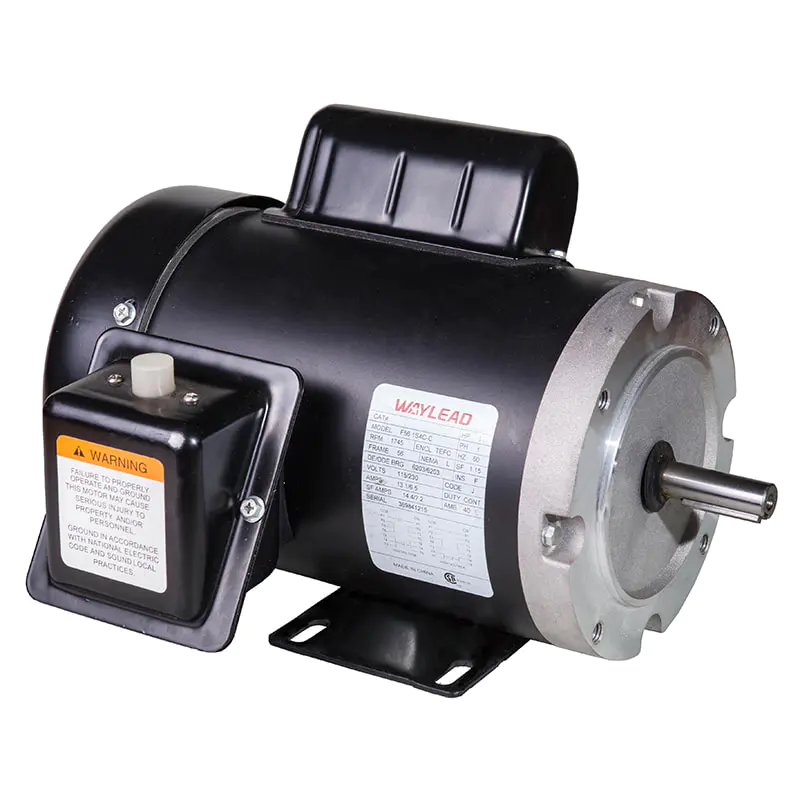
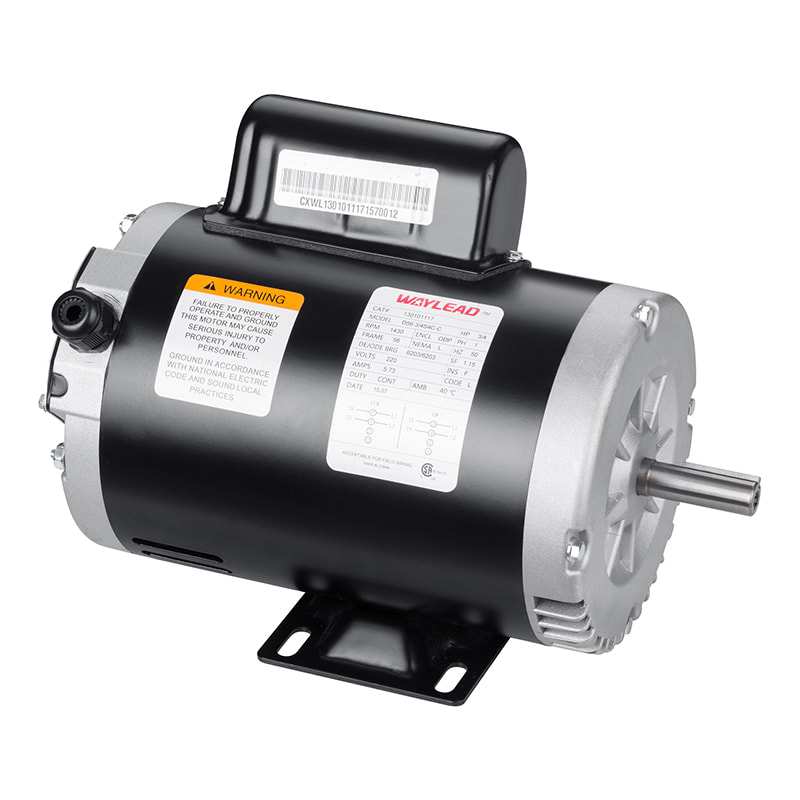 Single-Phase Fractional Horsepower Motor with Two CapacitorsFeaturing capacitor-start and capacitor-run design, this single-phase motor delivers higher starting torque for hard loads on single-phase supply. Certified and efficient, it fits pumps, compressors, and blowers.View Product →
Key Specifications to Check Before You Buy
A correct AC motor selection starts with rated power, speed, frame size, voltage, duty rating, and enclosure — everything else is secondary. The nameplate states the rated values, and those values must match both the supply and the driven machine. Horsepower is mechanical output, not electrical input; service factor (for example, 1.15) tells you how much overload the motor can carry continuously. Insulation class (B, F, or H) defines the allowable temperature rise, and duty rating (S1 continuous or S3 intermittent) tells you whether the motor may run indefinitely.
Frame size controls the mounting dimensions. NEMA frames 48, 56, 143T, and 182T are standard in North America, while IEC frames are dimensioned in millimetres. Mismatched bolt patterns and shaft heights cause vibration and bearing failure, so confirm the retrofit against a dimensional drawing. A manufacturer that builds both NEMA and IEC motors can usually supply those drawings quickly.
| Poles | 60 Hz (rpm) | 50 Hz (rpm) |
|---|---|---|
| 2 | 3,600 | 3,000 |
| 4 | 1,800 | 1,500 |
| 6 | 1,200 | 1,000 |
| 8 | 900 | 750 |
A practical sequence for replacing a failed motor:
- Record the old nameplate data — power, speed, voltage, frame.
- Measure the shaft height, shaft diameter, and bolt spacing.
- Confirm the supply: single-phase or three-phase, voltage, and frequency.
- Check the duty cycle — continuous, intermittent, or frequent starts.
- Compare efficiency class and enclosure before ordering.
Efficiency and Operating Cost
Efficiency, not purchase price, dominates the lifetime cost of an AC motor. In a continuously running machine, energy can exceed 95% of total life-cycle cost, which is why regulators set minimum efficiency levels. In North America, EISA rules require NEMA Premium efficiency for many general-purpose motors; internationally, IEC 60034-30-1 defines IE1 (standard), IE2 (high), IE3 (premium), and IE4 (super-premium) classes. NEMA Premium is broadly equivalent to IE3.
The payback is easy to calculate. An old 2 hp motor at 80% efficiency draws about 1.86 kW at full load; a premium-efficiency replacement at 90% draws about 1.66 kW. Running 4,000 hours per year, the difference is roughly 800 kWh, or about US$100 annually at a typical industrial tariff. Over ten years, that saving is several times the motor's price. When ordering, ask for certified efficiency data — a compliant motor will state its efficiency class or minimum full-load efficiency on the nameplate.
Matching the Motor to the Application
Choose the motor for the driven machine, not for a vague horsepower figure.
- Pumps — jet, pool and spa, and close-coupled JM/JP pumps need continuous duty, quiet bearings, and proper sealing.
- Air compressors — high starting torque and frequent start/stop capability.
- Fans and blowers — low starting torque, quiet long-running operation.
- Material handling — brake motors that stop and hold the load when power is removed.
Enclosure choice matters just as much. Open drip-proof (ODP) motors suit clean, dry indoor locations. Totally enclosed fan-cooled (TEFC) motors keep dust, moisture, and debris out of the windings and are the default for pumps, compressors, and outdoor installations. Totally enclosed non-ventilated (TENV) motors shed heat through the frame where fan cooling is impossible. If the site is dusty, humid, or washed down, choose TEFC; an open motor will absorb moisture and fail prematurely.
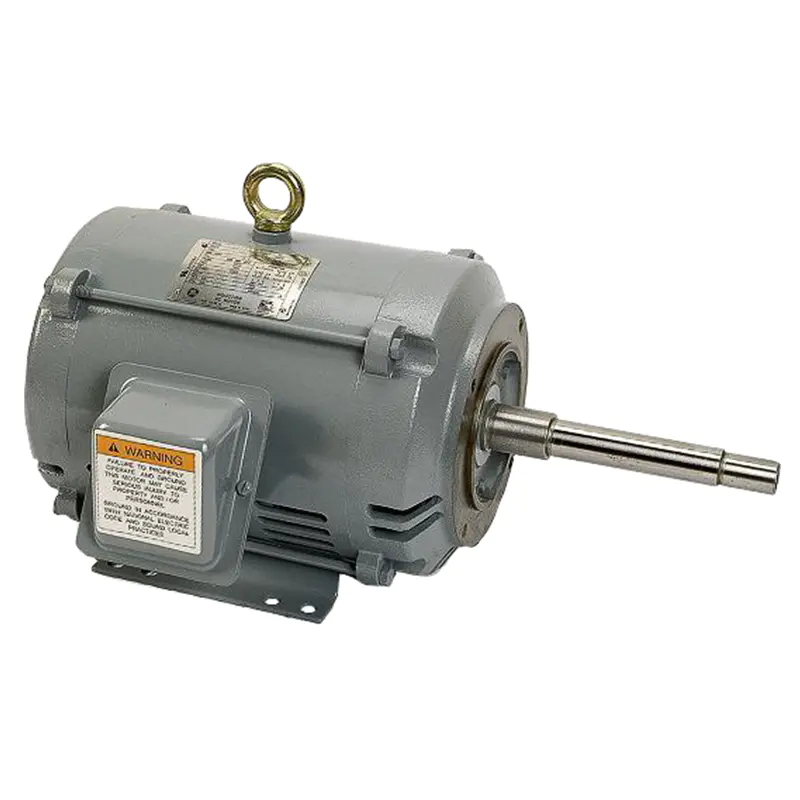
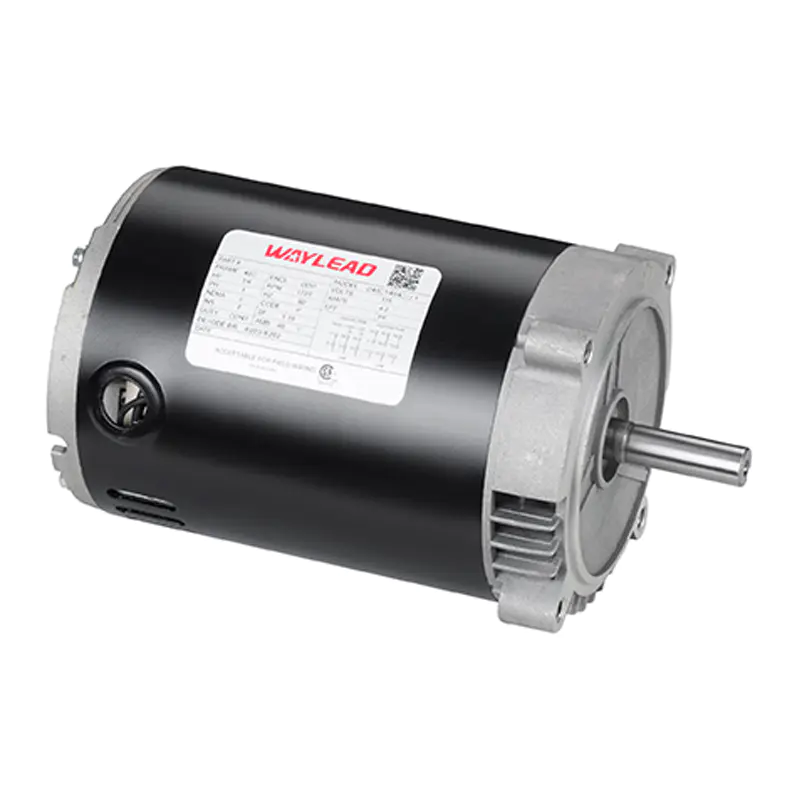 Single-Phase Pool and Spa Pump MotorDesigned for pool and spa pump applications, this motor offers adjustable service factors and F-class insulation. Its construction prioritizes moisture resistance, making it a suitable replacement for outdoor or humid environments.View Product →
Common AC Motor Failures and How to Prevent Them
Most AC motor failures trace back to overheating, moisture, voltage imbalance, or bearing wear — and all four are preventable with correct selection and routine checks.
| Failure | Typical cause | Prevention |
|---|---|---|
| Winding burnout | Overload, low voltage, blocked cooling | Check running current against the nameplate; keep air paths clean |
| Bearing failure | Misalignment, over-greasing, contamination | Align and couple correctly; regrease on the manufacturer's schedule |
| Insulation breakdown | Moisture, heat, voltage surges | Keep windings dry; measure insulation resistance before restart |
| Excessive vibration | Unbalance, soft foot, worn bearings | Balance the load; check mounting and tighten foundation bolts |
A short monthly routine — recording running current, temperature, vibration, and bearing sound — catches most problems early. For motors in storage, rotate the shaft occasionally and keep the terminals covered.
Frequently Asked Questions about AC Motors
What is the difference between an AC motor and a DC motor?
An AC motor runs on alternating current, and its speed is set by supply frequency and pole count. A DC motor runs on direct current and can be speed-controlled easily by varying voltage. AC motors are simpler, cheaper, and more common for fixed-speed industrial use; DC motors are used mainly in battery-powered equipment, servos, and precise speed-control applications.
Can a single-phase motor run on three-phase power?
No. A single-phase motor connected to a three-phase supply without the correct voltage rating will overheat or burn out. A three-phase motor connected to a single-phase supply will hum and draw heavy current without starting, because a single-phase supply cannot create a revolving field.
What is slip in an induction motor?
Slip is the difference between synchronous speed and actual rotor speed, usually expressed as a percentage. It is the mechanism that creates torque. Normal full-load slip for standard induction motors is about 2-5%.
What does the service factor mean on a motor nameplate?
Service factor is a multiplier on rated horsepower. A 1 hp motor with a 1.15 service factor can deliver 1.15 hp continuously at rated voltage without exceeding its allowed temperature rise. Treat it as a safety margin, not as permanent overload capacity.
How do I choose between ODP and TEFC motors?
In a clean, dry, ventilated area, an open drip-proof motor is adequate and runs cooler. In dusty, humid, or outdoor conditions, choose a totally enclosed fan-cooled motor so the windings are protected from contamination and moisture.